


 through our G2G profile

 LoL Accounts
 Valorant
 WoW accounts
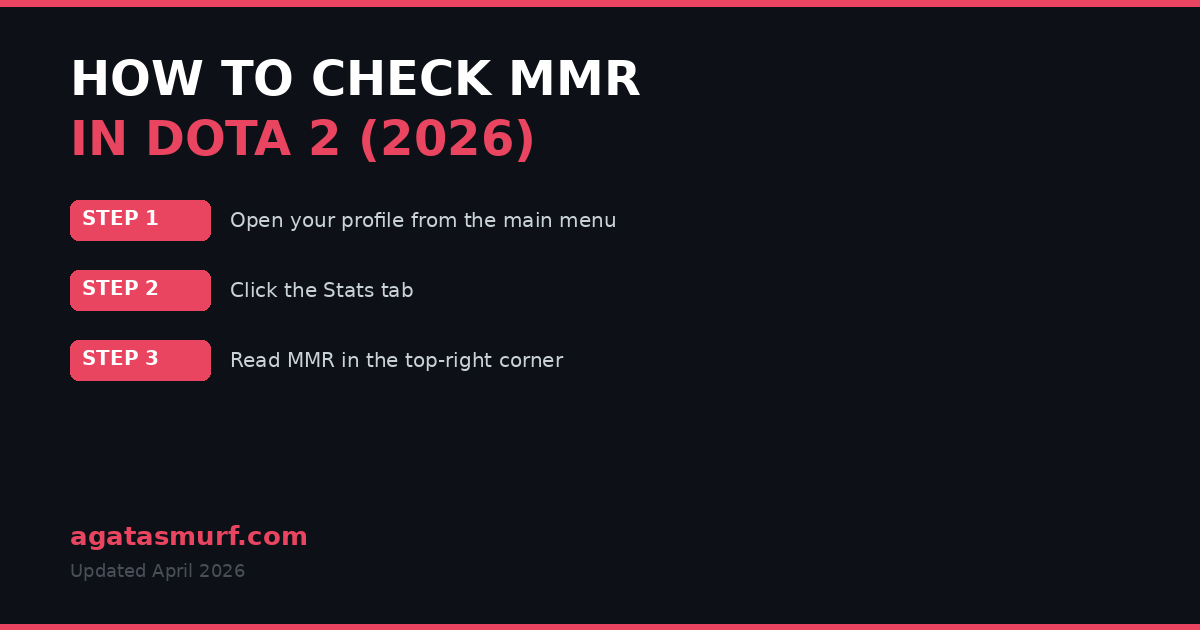
Wanna check MMR in Dota 2? Click your profile, hit the Stats tab, look at the top-right corner. Done. Your Matchmaking Rating sits right there, plain as day. If you want to check MMR Dota 2 players stress over every night, that three-click method is the only thing you need. Wins push it up, losses drag it down, and the average swing per solo game lands around 25 to 30 points since Valve rolled out the Glicko system in patch 7.33.
So what is MMR in Dota 2? It’s literally just a skill number. A Herald sitting at 300 gets paired with other Heralds. A Divine grinding at 5,000 fights other Divines. Pretty logical. But the ways to find it, track it, and figure out what it actually means? Those got way more confusing over the years.
I’m gonna break down every method (in-client, per role, third-party trackers), explain what changed with Rank Confidence, and cover the stuff that trips people up. This guide reflects the April 2026 state of the game.
Quick Reference: Everything You Need to Check MMR Dota 2
| What You Want | Where to Find It |
|---|---|
| Your current MMR | Profile > Stats > top-right corner |
| Your Rank Confidence | Same Stats page, next to MMR number |
| Role performance | Play Dota > hover Role Queue |
| MMR history over time | Dotabuff, OpenDota, or Dota2MMR.top |
| Opponent’s approximate rank | Their medal on loading screen or profile |
| Regional leaderboard (Immortal) | dota2.com/leaderboards |
| Rank distribution data | Stratz (7M+ player dataset) |
Step-by-Step: How to Check MMR in Dota 2
Takes five seconds, I timed it.
- Open your profile. Your name is up in the top-left of the main screen. Just click it.
- Go to Stats. You’ll see it sitting between your match history and other profile tabs.
- Read the number. Top-right of the Stats window. Your Rank Confidence percentage shows up next to it.
You’ll also spot your most-played heroes, win rates, and that pentagon performance chart on the same page. Good for catching bad habits. Every “how do I check MMR Dota 2 shows me” or “how to see MMR in Dota 2” question has the same three-word answer: Profile, Stats, top-right. Nothing about this part changed since 2017, even though Valve reworked almost everything else around it.
What Does MMR Mean in Dota 2?
MMR = Matchmaking Rating. Valve uses it to throw you into games with people at your skill level. Higher number, harder lobbies. That’s the whole concept.
But the math underneath has been reworked a bunch of times. Back in 2013, it ran on a basic Elo model. Then patch 7.33 dropped in 2023 (the “New Frontiers” update) and Valve swapped to a Glicko algorithm. Now the system tracks two things: your Rank (the MMR number) and Rank Confidence (how certain Valve is about that number). Play a ton of games in a week? Confidence goes up, and your MMR barely moves per game. Take three months off? Confidence tanks, and suddenly you’re gaining or losing 40+ points a match.
Timeline: How Dota 2 MMR Changed Over the Years
Old guides contradict each other because the system kept changing. Here’s the actual history of how to check MMR Dota 2 has used over the years:
| Year | What Happened |
|---|---|
| 2013 | Ranked launched. Your MMR was just a raw number on your profile. No medals, no tiers. |
| 2017 | Medal system arrived. Herald through Divine replaced the raw number. You could still show MMR on your profile card though. |
| 2019 | Valve split MMR into Core and Support. Role Queue went live. |
| 2020 | Core/Support merged back into one number. Role handicaps added per position instead. |
| 2023 | Patch 7.33 killed Elo, brought Glicko. Rank Confidence became visible. Every single account had to recalibrate. |
| 2025 | Immortal Draft threshold jumped to 8,500 MMR. Replays above that went private. Voluntary recalibration locked to once every 12 months. |
Checking the number itself (Profile > Stats > top-right) hasn’t changed since 2017. Everything else around it, though? Completely different game.
And one thing I keep seeing people get wrong on Reddit: your KDA doesn’t touch your MMR. Neither does hero damage or GPM. You can feed 0-10 and still gain MMR if your team clutches the win. Only the W or L matters.
Visible vs. Hidden MMR in Dota 2
Two separate ratings live on every Dota 2 account. Visible MMR is the one on your Stats page. Only ranked games move it. But there’s also a hidden MMR that Valve runs in the background for unranked matches and for seeding fresh accounts during calibration.
No way to see that hidden number anywhere in the client. Dotabuff gives a rough bracket estimate (Normal, High, Very High) for your unranked games, but that’s it. When you check MMR Dota 2 displays on the Stats page, you’re only seeing the ranked side. Hidden stays hidden. Always.
Behavior Score and Communication Score
Before you even touch ranked, Valve wants you above 3,000 Behavior Score. Dip below and your ranked queue just… disappears. You’re stuck in unranked until you grind it back up.
There’s also a Communication Score nobody talks about. You need 6,000 to type in chat. 8,000 to use voice. Imagine trying to coordinate a Roshan play when you literally can’t talk to your team. That’s what sub-8k Communication Score feels like, and it quietly kills your win rate without you even realizing why.
The lobby quality difference between 7k and 10k behavior score is wild, by the way. At 10k you actually get teammates who try. At 7k, someone’s breaking their items by minute 15. I’d say keeping behavior score high matters almost as much as the MMR grind itself.
Dota 2 Ranks and Their MMR Ranges
MMR maps directly to one of eight medals. Valve never published the exact thresholds (classic Valve), but Stratz and OpenDota crunch data from millions of profiles. Here’s where things land as of April 2026:
| Medal | Estimated MMR Range | Player Share (approx.) |
|---|---|---|
| Herald | 1 – 769 | ~7% |
| Guardian | 770 – 1,539 | ~16% |
| Crusader | 1,540 – 2,309 | ~22% |
| Archon | 2,310 – 3,079 | ~23% |
| Legend | 3,080 – 3,849 | ~16% |
| Ancient | 3,850 – 4,619 | ~9% |
| Divine | 4,620 – 5,619 | ~5% |
| Immortal | 5,620+ | ~2% |
Every medal except Immortal splits into five stars. One star equals roughly 154 MMR. Divine stars are chunkier at about 200 MMR each. Immortal drops stars entirely and goes straight to the regional leaderboard, updated hourly by Valve.
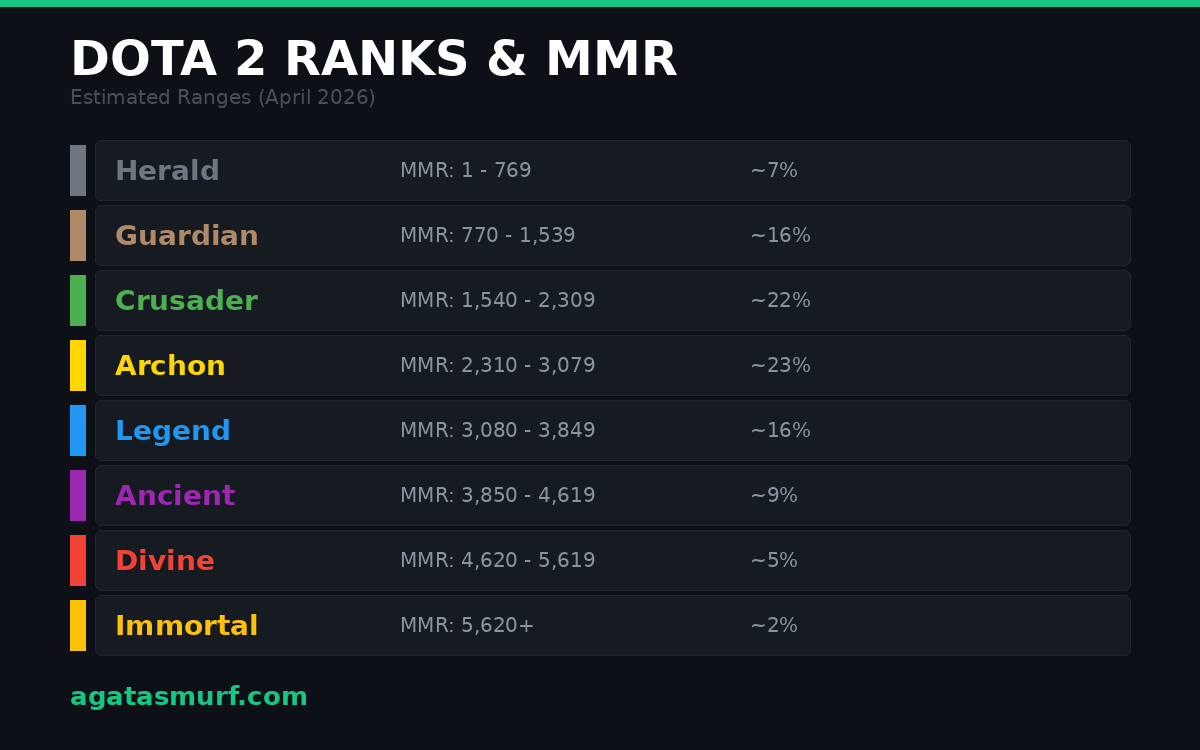
Most ranked players sit around Crusader 5 or Archon 1. Hit Legend and you’re already above 72% of the playerbase (per Stratz’s Season 6 data). Herald and Guardian together make up the bottom ~23%, while Ancient and above covers only about 16%. Numbers shift a bit month to month as people calibrate.
How to Check Your Role-Specific MMR
Valve merged Core and Support MMR back in 2020. One account, one number. But when you check MMR Dota 2 assigns per role, the game is still quietly running separate handicaps for Carry, Mid, Offlane, Soft Support, and Hard Support behind the scenes.
You can actually see these modifiers. Go to Play Dota, then hover over Role Queue. Small numbers appear next to each position.
- Click Play Dota on the main menu.
- Hover your mouse over Role Queue.
- Small modifier numbers pop up next to each role.
If you’re a pos 5 main who queues mid once a month, your mid handicap probably sits deep in the negatives. So what happens is Valve throws you into a softer mid lobby to compensate. I didn’t even know about this mechanic until I started wondering why my mid games felt so much easier than my support games at the same rank. Turns out the matchmaker was babysitting me the whole time. Explains a lot about those lobbies where one team just feels off.
Checking Someone Else’s MMR
Nope. Can’t do it. Valve hides everyone else’s number on purpose to cut down on flaming. Click another player’s profile and you’ll only see Profile, Trophies, and Tickets. No Stats tab, no MMR.
Their medal shows on the loading screen though. A Divine 3 is roughly around 5,200 MMR, give or take. Don’t treat it as exact because Rank Confidence can push people above or below their badge.
One workaround: if the player turned on “Expose Public Match Data” in their settings, Dotabuff and other third-party sites can scrape their stats. That’s the closest thing to a Dota MMR checker for other people’s profiles.
Third-Party Tools to Check Dota 2 MMR
This video walks through the Dota 2 ranking system and how tracking your MMR fits into the bigger picture of climbing.
Your Stats page only gives you a snapshot. Right now, this second, here’s your number. But it doesn’t tell you whether you gained 150 MMR this week or lost 200. If you want to check MMR Dota 2 tracked over time with actual graphs and match-by-match breakdowns, you’ll need a Dota 2 MMR tracker running outside the game client.
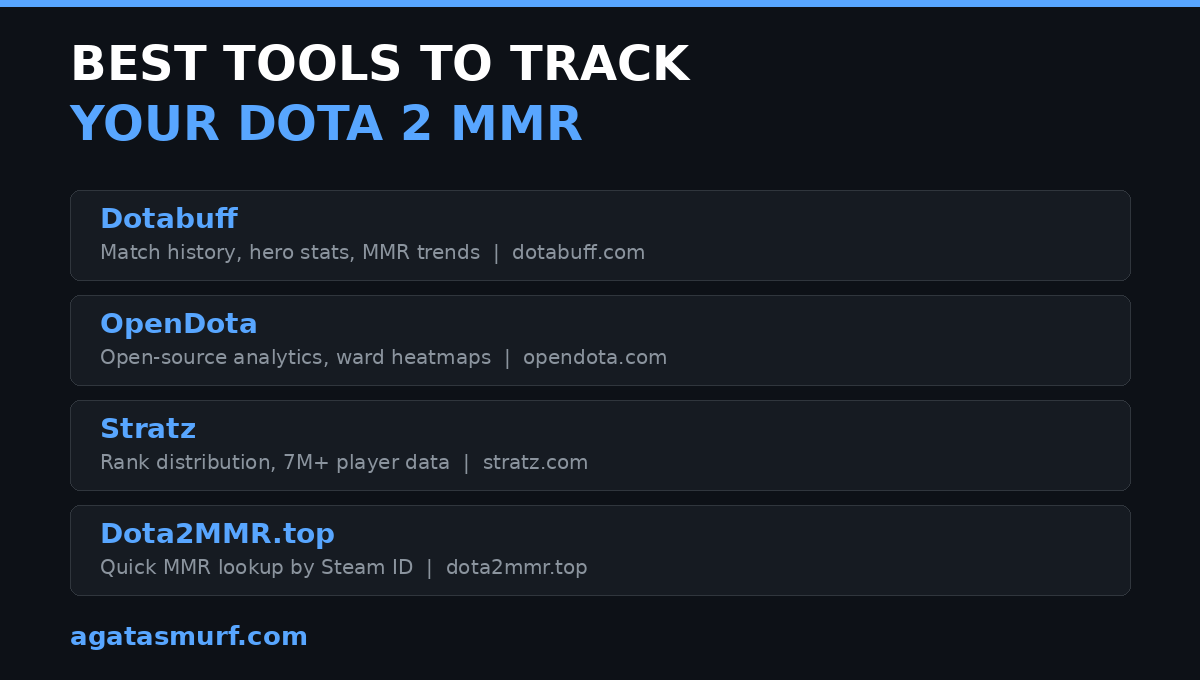
Best options right now:
- Dotabuff (dotabuff.com). been around forever. Log in with Steam and you get full match history, hero win rates, and estimated MMR trends. Pros and coaches both use it daily.
- OpenDota (opendota.com). open-source, great for nerdy stuff like ward heatmaps and teamfight breakdowns. Powers most of the rank distribution data floating around online.
- Stratz (stratz.com). the go-to for rank distribution. Their Season 6 sample covers 7+ million players. Want to know your exact percentile? This is where.
- Dota2MMR.top. dead simple. Paste a Steam ID, see MMR history. No login required.
Every one of these pulls from Valve’s Dota 2 API. You gotta enable “Expose Public Match Data” in your settings first (more on that below). If your profile looks blank on Dotabuff, that toggle is off.
Tracking Dota 2 MMR Changes via Developer Console
If you’re the type who wants to see the exact +27 or -31 flash on screen after every game (I am), there’s a community script method using the dev console:
- Go to Settings > Options > Advanced, enable Developer Console.
- Grab a trusted script. AveYo’s GitHub repo is the most popular one.
- Copy the script file into your Dota 2 game folder. Easiest way to find it: right-click Dota 2 in your Steam library, open Properties, and use Browse Local Files.
- Once you’re in a match, press
~to pull up the console and paste the command from the script’s readme.
After each ranked match, MMR pops up as a console overlay. Saves you from alt-tabbing to Dotabuff between games. Just know that Valve patches can break these scripts overnight. They usually get fixed within a day or two by the community.
Dota 2 MMR Not Showing? Here’s Why
Your Dota 2 MMR not showing is confusing, I know. I’ve gotten DMs about this from friends who thought their account was bugged. It’s almost always one of these three things:
You haven’t unlocked ranked yet. Under 100 hours, no linked phone, or calibration not done? Your MMR doesn’t exist yet. Literally. The Stats page shows nothing until all three boxes are checked.
Rank Confidence cratered. Took a long break? Months of inactivity drop your Rank Confidence. When it falls below ~30%, the medal and MMR number both vanish from your profile. They come back once you play enough ranked games for the system to rebuild trust. It’s basically an automatic soft recalibration.
Wrong screen. Your medal badge lives on the main menu (top-left). The actual MMR number is only inside Profile > Stats. People confuse these two constantly. Medal is always visible. The raw number? Stats page only.
If none of that applies, restart the client. After Valve updates, the profile page sometimes bugs out for a couple hours.
Unlocking Ranked and Getting Your First Dota 2 MMR
Brand new accounts don’t have MMR at all. You gotta earn it:
- Play 100 hours of unranked. Any mode counts, including Turbo.
- Link a phone number to your Steam account. Valve’s anti-smurf gate.
- Finish 10 calibration matches. Win-loss record during these games drives your starting MMR (Valve has never confirmed whether in-game stats matter during calibration, though people swear they do).
Calibration games feel awful sometimes. The matchmaker hasn’t figured you out yet, so lobbies can be all over the place. My honest advice: don’t sweat the placement. I’ve watched people calibrate 500 MMR too low and claw it back in a single week. Once Rank Confidence builds up, the system locks onto your real skill fast.
Recalibration: Should You Use It?
You can force a manual recalibration once per year. Settings > Account > MMR Recalibration. Fair warning: there’s zero confirmation popup. Click it and you’re instantly locked into 10 new placement games. The 12-month cooldown starts immediately too.
Most people skip it. If you’ve been playing regularly, your Confidence should already be accurate enough that normal wins and losses keep everything honest. Voluntary recalibration really only makes sense if you took a six-month break and feel like the system is way off.
Rank Confidence: Why Your Dota 2 MMR Swings
This is the part nobody reads and then wonders why their MMR is behaving weird. Patch 7.33 made Rank Confidence visible on your Stats page, right next to MMR. You can check MMR Dota 2 shows alongside this percentage on the same screen. It tells you how sure Valve’s algorithm is about your rating.
High Confidence (80%+) = small, predictable MMR shifts. Low Confidence (under 30%) = chaos mode. Wild swings, uneven lobbies, and if it drops below ~30%, your medal can straight up disappear until you play enough games to bring Confidence back.
Confidence decays when you don’t play. A month off and your first games back will feel like a different game. You might gain 42 MMR for a win or lose 38 for a loss. It’s not a punishment, it’s recalibration in real time.
The Math Behind MMR Gains and Losses
Old system gave a flat 25-30 MMR per game. Glicko is messier (but smarter). Three things determine your rating change:
- Rating (R). your actual MMR number.
- Rating Deviation (RD). Valve’s uncertainty about that number. High RD = big swings. RD is basically Rank Confidence flipped upside down.
- Volatility. measures how unpredictable your match results are. If you flip between winning streaks and losing streaks constantly, volatility stays high. Grind steadily upward and it drops.
Real example: you’re a 3,500 MMR Legend player with solid Confidence. You win against a team averaging 3,600. Maybe +28 MMR. Now imagine you just came back from two months off and Confidence is shot. Same win? Could be +38 or +42 because the system is still racing to pin down your real rating.
And here’s the part that actually stings. When the system expects you to win, losing costs more than winning pays. Picture this: you’re sitting at 4,000 MMR in Ancient, and the lobby average is only 3,600 because it’s packed with Legends and Archons. You lose that game? Might drop 33 MMR. Win it? Maybe only +22. The math pushes you toward the point where your expected win rate lands at 50%, and that process is painfully slow. That’s what’s actually happening when people feel hardstuck in Guardian or Crusader with a 52% win rate. They are climbing, just at a crawl.
How to Enable “Expose Public Match Data”
This trips up so many people. You log into Dotabuff, search yourself, and… nothing. Empty profile. Three clicks fix it:
- In Dota 2, open Settings (that gear icon sitting in the top-left).
- Scroll through Options until you reach Advanced Options at the bottom.
- Tick the checkbox next to “Expose Public Match Data”.
Now every third-party site can pull your history through the Valve API. No downside, no privacy risk (it’s match data, not personal info). Turn it on day one and every Dota 2 MMR check through external tools actually works. It also lets sites estimate your Dota 2 rank MMR more precisely because they can see recent match brackets.
Immortal MMR in Dota 2 and the Leaderboard
Cross 5,620 MMR and you enter Immortal. Stars stop existing. What matters now is where you sit on the regional leaderboard. Break into the top 5,000 and a number shows up on your medal. Crack the top 100 or top 10 and the badge itself changes to a different visual tier.
Valve made the Immortal grind even more exclusive in March 2025. The Immortal Draft threshold went from 6,500 to 8,500 MMR. Games above that line run a completely different format: two players get picked as captains and draft their teammates from a pool of eight. Replays for those matches are also locked from public view. If you want to learn how 10k+ MMR players think, you gotta watch their Twitch streams because the in-game spectate system won’t show you anything.
As for the all-time MMR record, that belongs to Ilya “Yatoro” Mulyarchuk. The former Team Spirit carry was the first person to hit 16,000. Right now in April 2026, a handful of EU ladder grinders have pushed past 15,000 too, and that number keeps creeping higher every month.
How Dota 2 MMR Compares to Other Ranked Systems
If you grind more than one competitive game, the rating systems can blur together. Here’s a side-by-side so you can see where Dota sits.
| Game | Rating Name | Visible? | Gain/Loss Per Match | How to Check |
|---|---|---|---|---|
| Dota 2 | MMR | Yes (Stats tab) | ~25-30 (variable) | Profile > Stats > top-right |
| League of Legends | LP (hidden MMR behind it) | LP yes, MMR no | ~25 LP standard | Ranked tab in client |
| Valorant | RR (Rank Rating) | Yes | 10-30 RR | Career tab after match |
| Marvel Rivals | Ranked Points | Yes | Variable by rank | Competitive screen |
| CS2 | CS Rating | Yes | Variable (Glicko-2) | Player profile |
Biggest difference? When you check Dota 2 MMR, you see the raw number the matchmaker actually uses. No LP wrapper like League, no capped display like Valorant. Just the real score. Honest but kind of brutal when you watch an MMR loss tick down after a bad game.
FAQ: Checking MMR in Dota 2
How do I check my MMR in Dota 2?
Profile > Stats tab > top-right corner. That’s the only native way to see MMR Dota 2 shows in the client. Takes three clicks.
Can I see another player’s MMR?
No, Valve keeps that number locked. You can see their medal on the loading screen, and that’s about it. For a deeper look, a Dota MMR checker like Dotabuff can pull an estimate from their match data, but only when they’ve toggled their profile to public.
What separates MMR from the medal on my profile?
MMR is what Valve’s matchmaker actually reads when building your lobby. The medal is just a visual label that roughly corresponds to an MMR range. Medals don’t update instantly though. You could gain 300 MMR and still see the same badge for a while until you cross the next threshold.
How much MMR per game?
Depends on Rank Confidence and lobby balance. Average is 25-30 per solo match, but it can swing to 40+ if your Confidence is low. Glicko makes it variable, not fixed.
Best tools to track MMR over time?
Dotabuff, OpenDota, Stratz, Dota2MMR.top. All free, all pull from Valve’s API. Enable “Expose Public Match Data” in settings first or they can’t see your profile.
Does MMR decay from inactivity?
The number itself stays put. Rank Confidence is what decays. Play a few games after a break and the swings settle down once the system is confident again.
How do I unlock ranked?
100 hours of unranked play, a linked phone number, and 10 calibration games. After that your starting MMR and medal get assigned.
Tips to Raise Your Dota 2 MMR
Knowing how to check MMR Dota 2 gives you is step one. Here’s what makes it go up instead of sideways:
- 3 to 5 heroes, that’s your pool. I spammed Dazzle for 80 straight games in Archon. My win rate on him was 15% higher than my average. Consistency beats hero variety every time when you’re trying to climb.
- Stop playing after two Ls. Tilted queuing is how you donate 200 MMR in one evening. I’ve done it, you’ve done it, we all know how it ends.
- Actually look at your Dotabuff losses. Deaths, ward purchases (if support), CS numbers (if core). Pick one thing to fix per week. Not five, just one.
- Queue at the same time every day. Late-night lobbies in smaller regions like Australia or South America pull from wider MMR pools. Games feel more coinflippy. Prime time queues are just better.
For the full medal breakdown and distribution percentages, our Dota 2 ranks and MMR guide covers every tier in detail.
If you also play League, the ranked ladder runs differently. The League of Legends ranked system explained page breaks down how LP and hidden MMR work side by side. And for Marvel Rivals players, the Marvel Rivals ranks article covers Ranked Points and the medal structure there.
Want to look up ranked data across multiple games from one spot? Our MMR Checker tool handles that. More guides, tier lists, and rank breakdowns live on the AgataSmurf blog if you’re looking for your next read.
Last updated: April 2026. Data sourced from Stratz, OpenDota, and Valve’s official leaderboard page.
