League of Legends Map Overview
Summoner’s Rift is the League of Legends map. Ranked, Worlds finals, your Bronze 4 promos at 3 AM, all of it happens here. Riot dropped a Demacia-themed visual refresh in Season 16 (Patch 26.1) and threw in Faelights plus Role Quests on top. So yeah, if you haven’t logged in for a few months, the Rift looks and plays different now. Coming back after a break? You can create a LoL account in about five minutes.
I break down the Rift lane by lane, go through all the camps and objectives, and cover what changed in Season 16. The other maps (ARAM, Arena, Brawl) get a section too.

Quick Reference: Summoner’s Rift at a Glance
| Element | Details |
|---|---|
| Map Size | Square layout, roughly 15,000 x 15,000 in-game units |
| Lanes | Top, Mid, Bot (3 total) |
| Turrets Per Lane | 3 (Outer, Inner, Inhibitor) + 2 Nexus turrets |
| Jungle Sides | Blue side (southwest) and Red side (northeast) |
| Epic Monsters | Elemental Drakes, Rift Herald, Baron Nashor, Void Grubs, Elder Dragon |
| Current Theme (2026) | Demacia (Season 16, Patch 26.1+) |
| New Mechanics (S16) | Faelights, Role Quests, Crystalline Overgrowth |
| Objective | Destroy the enemy Nexus |
Summoner’s Rift: The Main League of Legends Map
Two teams, opposite corners, 5v5. Blue team starts bottom-left, red team top-right. Check out the official Summoner’s Rift wiki page for the full layout. Three lanes connect the bases with camps scattered between them. A river runs diagonally through the center and that is where all the big objective fights happen.
Goal: destroy the enemy Nexus. Sounds simple. You have to crack three turrets per lane first, then the inhibitor, then two more turrets guarding the Nexus. That is a lot of structures. Most solo queue games take 25 to 35 minutes. The whole LoL ranked system runs on this map, so learning it matters.
The Three Lanes Explained
There are 170+ champions in the game now. Most fit into one of five roles. Pick the wrong one for your lane and you are already behind before minions even spawn.
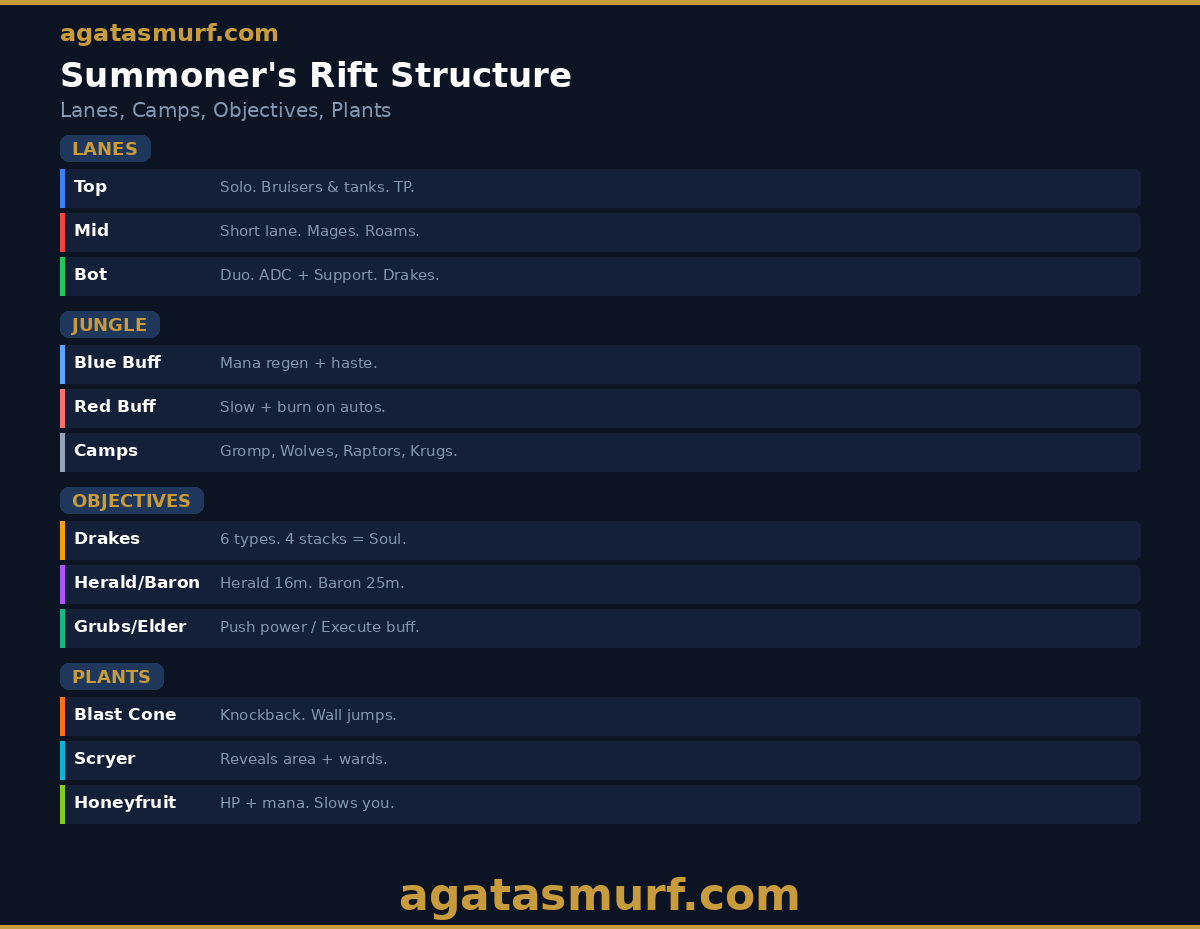
Top lane runs along the upper-left edge. Longest lane on the map and nobody comes to help you up here. Bruisers, tanks, and the occasional ranged bully live in this lane. Dragon is on the other side of the map, so your team mostly ignores top early. You are on your own in a 1v1 where wave management wins more fights than mechanics do. Most top laners take Teleport so they can actually show up to teamfights when they matter.
I’ve spent way too many games stuck in a Darius vs. Garen top lane where nothing happens for 10 minutes. Peaceful until the jungler shows up.
Mid lane sits dead center, shortest path between the two bases. Mages, assassins, and a few control picks live here. Why mid matters so much: you can reach either side of the map faster than anyone else. Shove one wave, roam bot, pick up a kill, walk back. A good mid laner can flip the entire game off a single roam.
Bot lane is the duo lane. Your ADC (attack damage carry) and support go here together. Bottom-right edge of the map. Bot lane matters early because it is closest to the Dragon pit, so having lane priority down here often decides which team gets the first drake. Your support handles most early vision around river too. Without those wards, your jungler gets collapsed on and dies.
How the Camps and Pathing Work
All that space between the lanes? That is where the jungler lives. The area splits into four chunks: blue topside, blue botside, red topside, red botside. Mirror image. Same camps on both sides, same positions.
| Camp | Location | Key Buff / Reward |
|---|---|---|
| Blue Sentinel | Blue side jungle | Crest of Insight (mana regen + ability haste) |
| Red Brambleback | Red side jungle | Crest of Cinders (slow + burn on attacks) |
| Gromp | Near Blue Buff | Gold + XP |
| Wolves | Between Blue Buff and mid lane | Gold + XP |
| Raptors | Near Red Buff | Gold + XP (6 small + 1 large) |
| Krugs | Near Red Buff (far side) | Gold + XP (split into many small units) |
| Rift Scuttler | River (top and bot) | Vision + speed shrine, gold + XP |
Clear camps, get gold and XP, look for ganks. That is the job. Better junglers also track where the enemy is on the League of Legends map by watching the minimap and dropping wards. You spot them farming raptors? Your top laner can play aggressive for the next 30 seconds because nobody is coming. Tracking your own hidden MMR helps you understand matchmaking quality too.
Epic Monsters on the League of Legends Map
River fights decide most games. Four types of epic monsters spawn at different timers, and contesting them is usually what separates winners from losers.
This video from Skill Capped breaks down how the map works from scratch, including objectives and lane assignments.
Elemental Drakes
Drakes spawn in the pit (bottom side of the river) starting at 5 minutes. Each one gives a permanent stacking buff to the team that secures the kill. The element is random for the first two, then the third drake’s element locks in for the rest of the game and transforms the surrounding terrain.
Six elemental types exist: Infernal (bonus damage), Mountain (armor and magic resist), Ocean (health regen), Cloud (movement speed), Hextech (ability haste and attack speed), and Chemtech (tenacity and healing). After one team claims four drakes, they earn the Soul, a powerful permanent buff based on the dominant element. Elder spawns next, and its buff is a true execute on low-health enemies. Securing Elder basically ends the game if you don’t throw the fight after.
Rift Herald and Baron Nashor
Rift Herald spawns at 16 minutes on the top side of the river (Season 16 timing, pushed back from 14 in previous years). Killing it drops an Eye that you can pick up and summon later to charge into an enemy turret. Herald is great for cracking open top or mid tier-one towers when the enemy team is focused bot side.
Baron Nashor replaces the Herald at the 25-minute mark. Baron is the strongest neutral objective on the League of Legends map and requires your whole team to take it safely. The buff empowers nearby minions and gives your team bonus AD and AP, making sieges much easier. Throwing at Baron is one of the most common ways to lose a game you were winning, so be careful.
Void Grubs
Void Grubs are a more recent addition. They spawn on the bot side early in the game. Killing them gives your team Voidmites that push lanes alongside your minions. They are not as flashy as drakes or Baron, but the extra push pressure adds up over time. In Season 16, Riot made Void Grubs easier for non-junglers to take, so laners sometimes rotate to grab one between waves.
Terrain Plants on the Rift
Three types of interactive plants grow across the map. Most new players walk right past them. Big mistake. These things can save your life or set up a kill.
Blast Cone spawns near buff camps and in the river. Hitting it launches every nearby champion (including you) away from the center. You can use it to jump over walls, escape ganks, or knock an enemy into your team. Junglers use Blast Cones near Baron and drake pits to surprise steal objectives.
Scryer’s Bloom appears along the river edges. Attacking it sends out a wave of pollen that reveals everything it touches, including hidden wards and stealthed champions. Basically a free sweeper on a cooldown. In Season 16, Scryer’s Bloom respawn timers got adjusted alongside the Faelight system.
Honeyfruit grows along the river banks. Walking over the dropped fruit restores health and mana but briefly slows you. Useful for staying in lane after a rough trade, but be careful because enemies can use your slow against you.
Elemental Rift: 6 Terrain Transformations Explained
When the third drake spawns, the League of Legends map permanently transforms based on that element. Walls shift, new brushes appear, or terrain opens up. No other MOBA does this, and it directly changes how the mid-to-late game plays out.
Infernal Rift: Walls crumble near buff camps, opening up new pathways and removing brush. Fights become more open and harder to escape from.
Ocean Rift: Extra brush grows in the river and near camps. Honeyfruit spawns more frequently. Picks and ambushes become easier because there are more hiding spots.
Mountain Rift: New rock formations and walls appear near buff camps and in the river. Choke points get tighter, making it easier to zone enemies off objectives.
Cloud Rift: Wind tunnels spawn around the map that grant bonus movement speed when you walk through them. Rotations between lanes get faster.
Hextech Rift: Hextech gates appear in pairs. Walk into one and you teleport to the linked gate across the map. This creates unexpected flanking routes and faster rotations.
Chemtech Rift: Camouflage zones spawn near pits and camp areas. Champions inside are hidden unless an enemy walks close enough. Ambushes and objective steals become way more common.
Pay attention to which Rift locks in. Mountain? Fight in choke points. Cloud? Play for cross-map speed. Most people below Diamond just ignore the terrain change entirely and wonder why they lost.
Season 16 League of Legends Map Changes: Demacia Theme and New Mechanics
Patch 26.1 hit in January 2026 and Summoner’s Rift went full Demacia. Gone is the dark Noxus vibe from 2025. Now everything is bright stone, blue and gold banners, Demacian-style turrets and inhibitors. Looks clean.
But the real changes go beyond cosmetics.
Faelights
Faelights are glowing rings scattered across the Rift. Near base gates, tucked into island brushes, along river walls. Drop a ward on one and it temporarily reveals a huge area around it. Supports in my ranked games already prioritize Faelight spots over the old tri-bush wards. Honestly, it works. One well-timed Faelight ward has saved my team from Baron sneaks more than once.
Role Quests
Every position now gets a unique quest at game start. Top, mid, and bot earn points by farming, getting kills, and taking plates. Supports still upgrade World Atlas. Junglers still grow their companion. ADCs can unlock a seventh item slot (yes, really). Supports get an extra ward charge. Mid laners get faster recalls. All of these kick in around the 12-15 minute mark if you are farming decently.
Role Quests were controversial on launch. A lot of players felt like Riot was forcing them to “play correctly” instead of doing creative stuff like lane swaps. Riot wanted each position to have a clear identity early and kill the pro play lane swap meta. Love them or hate them, Role Quests are staying.
Other Season 16 Changes
Atakhan is gone. Blood Roses are gone. Feats of Strength? Also gone. Riot said these features added too much complexity without enough payoff. First Blood and first turret gold are back to their old values. Nexus turrets now respawn after being destroyed (3-minute delay), so backdooring is way harder. And Crystalline Overgrowth? New thing that builds up on towers over time. Hit it to deal bonus damage to turrets. Siege and split push actually feel rewarding again because of it.
Blue Side vs. Red Side on the LoL Map
Blue side (bottom-left) has a slight edge. Camera angle makes skill shots easier to land when you are shooting upward. Dragon pit access is better from blue bot lane too. Red side (top-right) gets first ban pick in champ select, so it somewhat evens out.
Below Diamond, you won’t notice it. In high elo and pro play though, blue side sits at a 51-52% win rate pretty consistently. Riot keeps tweaking camera angles and objective positions to fix it, but the asymmetry is just how the map works. You learn to play around it.
Other Maps in League of Legends (2026)
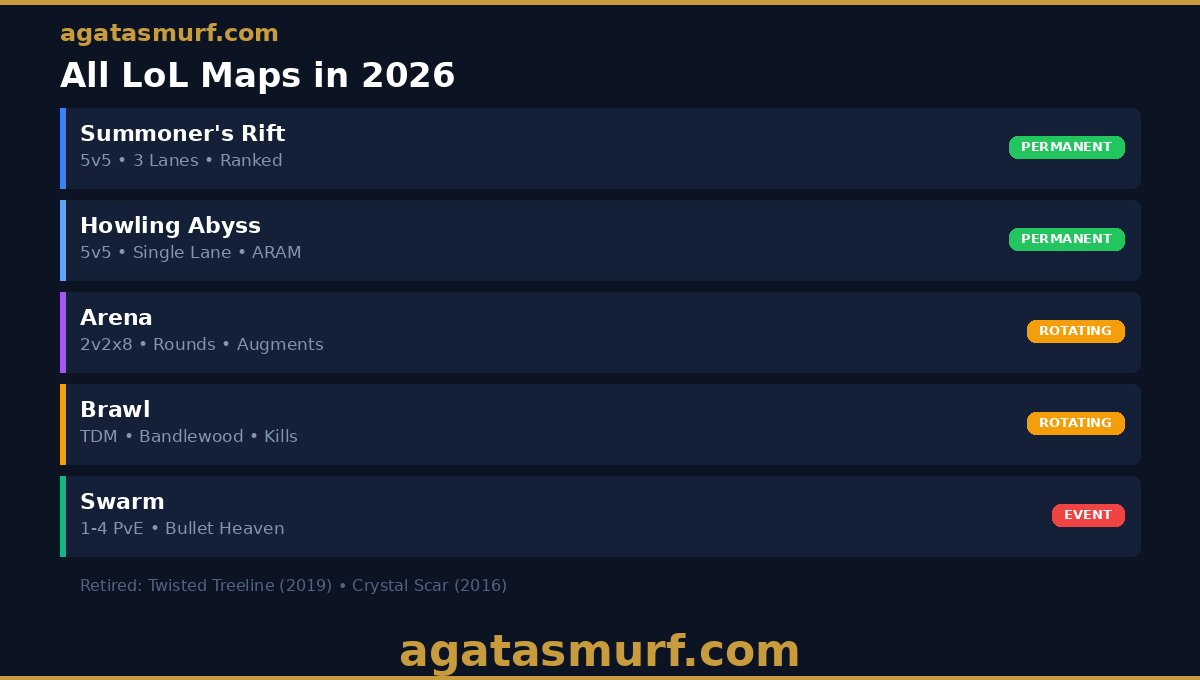
Summoner’s Rift gets all the attention, but the League of Legends map pool actually goes beyond one battlefield. A few other options are worth knowing about, especially when ranked is making you want to uninstall.
Howling Abyss (ARAM)
One lane. Random champions. No jungle camps. You cannot recall, so the only way to buy items is to die first. Howling Abyss strips League down to pure teamfighting, and games usually wrap up in 15 to 25 minutes.
ARAM is probably the most played casual mode in the game right now. Tilted from ranked? Queue up a couple ARAM games and reset your mental. Or hop on a LoL smurf account and play normals without stressing about LP. Riot added “ARAM Mayhem” balance adjustments in Season 16 that tune specific champion damage up or down, so poke comps don’t auto-win every game anymore.
Riot also reskins the Abyss for events sometimes. Koeshin’s Crossing has a Spirit Blossom look, Butcher’s Bridge goes full pirate. Same gameplay, different paint job.
Arena
Arena throws eight teams of two into a deathmatch bracket. You fight in rounds, pick Augments between them to power up, and the last team standing wins. Plays nothing like standard League. Riot brings Arena back a few times per year as a featured mode, and honestly it slaps when you just want to brawl without thinking about wave states.
Brawl
Brawl is a team deathmatch mode that launched in 2025 on its own map called The Bandlewood. Closest thing to a traditional deathmatch League has ever had. Teams respawn and fight over kill score. Brawl also rotates as a featured mode.
Retired League of Legends Maps
Old heads might remember Twisted Treeline (3v3) and The Crystal Scar (Dominion’s capture-point mode). Both are dead. Riot killed Dominion in 2016 and Treeline in 2019. Not enough people played them to justify the upkeep. Some players still miss the 3v3 scrappy games Treeline gave us, but those maps are not coming back.
Reading the League of Legends Map: Minimap Tips
Bottom-right corner of your screen. That tiny square? That is the minimap. Some people move it to the bottom-left in settings. Either way, you should be staring at it way more than you currently do. Checking the minimap constantly is probably the single biggest gap between Gold and Platinum players.
Here is what you should be watching for:
- Enemy positions. Four enemies visible bot side? Top lane can play forward. Nobody showing on the map at all? Back off. Someone is coming.
- Jungle tracking. Spot the enemy jungler clearing Raptors through a ward? They are stuck on that side for at least 20-30 seconds. Ping your team.
- Objective timers. Drake and Baron timers show on the minimap. Start moving 30-40 seconds early so your team is already in position when it spawns.
- Wave states. Big minion wave crashing into a side lane turret and nobody catching it? Free gold gone and probably a turret too.
Glance at the minimap every 3-5 seconds. Feels weird at first, yeah. After a hundred games you stop thinking about it. I picked up this habit after getting ganked three times in a row during Gold promos, and my death count dropped by about two per game from that alone.
Vision Control on the LoL Map
Wards win games. Proper vision control separates good teams from great ones. Every player gets a free Stealth Ward trinket at level 1. Place your first trinket in a spot that protects against early invades or river ganks.
Spots that give you the most coverage:
- River pixel brush (the small bush in the center of the river near mid lane). Catches enemy pathing between top and bot side.
- Tri-brush (the triangle-shaped brush near bot lane outer turret). Shields the ADC/support from ganks through the entrance behind them.
- Pit entrances. Before a major objective spawns, place vision inside the pit and along the approach paths.
- Enemy camp entrances. Deep trinkets near the enemy Raptor camp or Blue Sentinel tell you exactly where their pathing starts.
- Faelight spots (new in S16). Placing a trinket on a Faelight gives temporary large-area vision. Prioritize these during mid-game rotations.
Oracle Lens (sweeper trinket) becomes available at level 1 too, and supports usually swap to it after their first back to deny enemy information. Walking into Baron pit with no sweeper active is asking to get collapsed on from fog.
Map Control and Macro Strategy
Understanding the layout is one thing. Controlling it is another. Map control means owning territory through vision, wave pressure, and objective threat. A team that dictates where fights happen forces the enemy to react instead of making proactive plays.
A few principles that hold at every elo:
Push side waves before objectives. Say drake spawns in 40 seconds. Shove top and mid waves out first. Your opponents then face a lose-lose: catch the wave and give up the objective, or contest and lose turret plates.
Group near objectives in mid game. Once laning phase ends (roughly 14-18 minutes), moving with your team around contested areas beats farming a side lane alone. Split pushing is the exception, and only works if your champion wins the 1v1 and your team can hold 4v4 elsewhere.
Steal enemy camps. Clearing their monsters denies gold and XP while boosting your own economy. After winning a teamfight, hitting their camps is often smarter than forcing a turret you cannot finish.
None of this is new. The Rift has always rewarded teams that play proactively around timers rather than waiting for the enemy to misplay.
Frequently Asked Questions
How many maps does League of Legends have in 2026?
League of Legends has two permanent maps: Summoner’s Rift and Howling Abyss. Arena and Brawl rotate in and out as featured game modes throughout the year, each with their own maps. Event-specific maps like Swarm also appear during limited-time events.
What are the three lanes on Summoner’s Rift?
The three lanes are top lane (upper-left edge, usually bruisers and tanks), mid lane (center of the map, mages and assassins), and bot lane (lower-right edge, ADC and support duo). The jungle fills the space between all three.
What changed on the League of Legends map in Season 16?
Season 16 (Patch 26.1, January 2026) introduced a Demacia-themed visual overhaul, Faelights for improved vision control, Role Quests for all five positions, the removal of Atakhan and Feats of Strength, respawning Nexus turrets, and the Crystalline Overgrowth mechanic.
What epic monsters spawn on Summoner’s Rift?
Five epic monster types spawn on the Rift: Elemental Drakes (in dragon pit, stacking buffs), Rift Herald (top river, spawns at 16 min), Baron Nashor (top river, replaces Herald at 25 min), Void Grubs (bot side, early game), and Elder Dragon (after Dragon Soul is claimed).
Is Twisted Treeline still in League of Legends?
No. Riot permanently removed Twisted Treeline in November 2019 due to low player population. The Crystal Scar (Dominion) was removed in 2016. Neither map is expected to return.
What is the difference between blue side and red side?
Blue side starts in the bottom-left of the map, red side in the top-right. Blue side has a slight win rate advantage (around 51-52% in high elo) because of camera angle benefits and easier Dragon pit access. Red side gets first ban pick in champion select to compensate.
Last updated: April 2026