


 through our G2G profile

 LoL Accounts
 Valorant
 WoW accounts
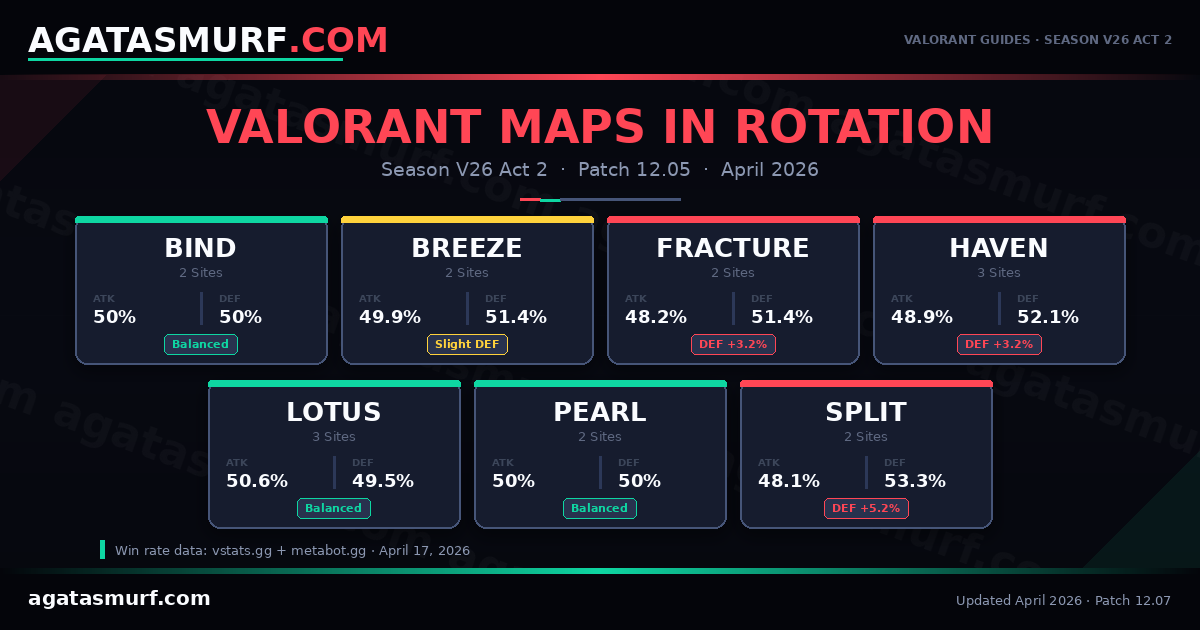
Riot locked in the current Valorant maps in rotation on March 17, 2026 with Patch 12.05. Seven maps, same as always: Bind, Breeze, Fracture, Haven, Lotus, Pearl, Split. Patch 12.07 came out April 14 and changed nothing about the pool. So what you queue into today is what you queued into three weeks ago. Abyss and Corrode are gone. Fracture and Lotus came home.
I am going to skip the fluff. Below is what each map actually plays like in Act 2, which side the data says wins more rounds, and the agents putting up weird win rates that nobody is talking about. Numbers are pulled from vstats.gg and metabot.gg API data through April 17, 2026. Not vibes. Not outdated reddit threads from two Acts ago.
The 7 Valorant Maps in Rotation (V26 Act 2) With Win Rate Data
Before you scroll, a heads up: the “who it favors” column ignores old reputations and shows what the API actually says. Some of these will surprise you. Haven being defender-favored. Fracture being defender-favored. Split sitting at the biggest defender gap in the pool. Modern ranked does not play how the 2022 tier lists told you it would.
| Map | Sites | Attack WR | Defense WR | Who Wins | Top Agent (WR) |
|---|---|---|---|---|---|
| Bind | 2 | ~50% | ~50% | Balanced | Cypher |
| Breeze | 2 | 49.9% | 51.4% | Slight defender | Killjoy (54.3%) |
| Fracture | 2 | 48.2% | 51.4% | Defender (+3.2%) | Sova (72%) |
| Haven | 3 | 48.9% | 52.1% | Defender (+3.2%) | Brimstone (63.9%) |
| Lotus | 3 | 50.6% | 49.5% | Balanced | KAY/O |
| Pearl | 2 | ~50% | ~50% | Balanced | Sova |
| Split | 2 | 48.1% | 53.3% | Defender (+5.2%) | Sova (62.7%) |
Two things jump out. Haven being defender-favored flips the old narrative. Everyone has been saying “three sites stretches defenders thin” for four years, and at pro level maybe that is true. At ranked average it is not. Defender util on Haven is so strong that retakes are easier than the layout suggests. Same deal with Fracture. The split-spawn attacker pressure sounds scary on paper, and then you play the map and realize defenders just anchor both sites with util and farm kills.
Breeze is the outlier. The old reputation still matches the numbers. Slight defender edge, heavy Op dependency, whoever wins the long corridor fights wins the round. Nothing about the rework changed that fundamental truth.
Act 1 vs Act 2: What Actually Changed
Two swaps. Five holdovers. That is the max shuffle Riot does in a single Act transition. Abyss and Corrode packed their bags. Fracture and Lotus walked back in. If you were expecting a brand new map or three, not this Act. Maybe never again, because Corrode was Valorant’s 12th map and Riot has been slowing down the release pace ever since Patch 11.00.
The Valorant maps in rotation update on a 2-month cadence now. Act 3 should drop around late May or early June 2026 and bring the next round of changes.
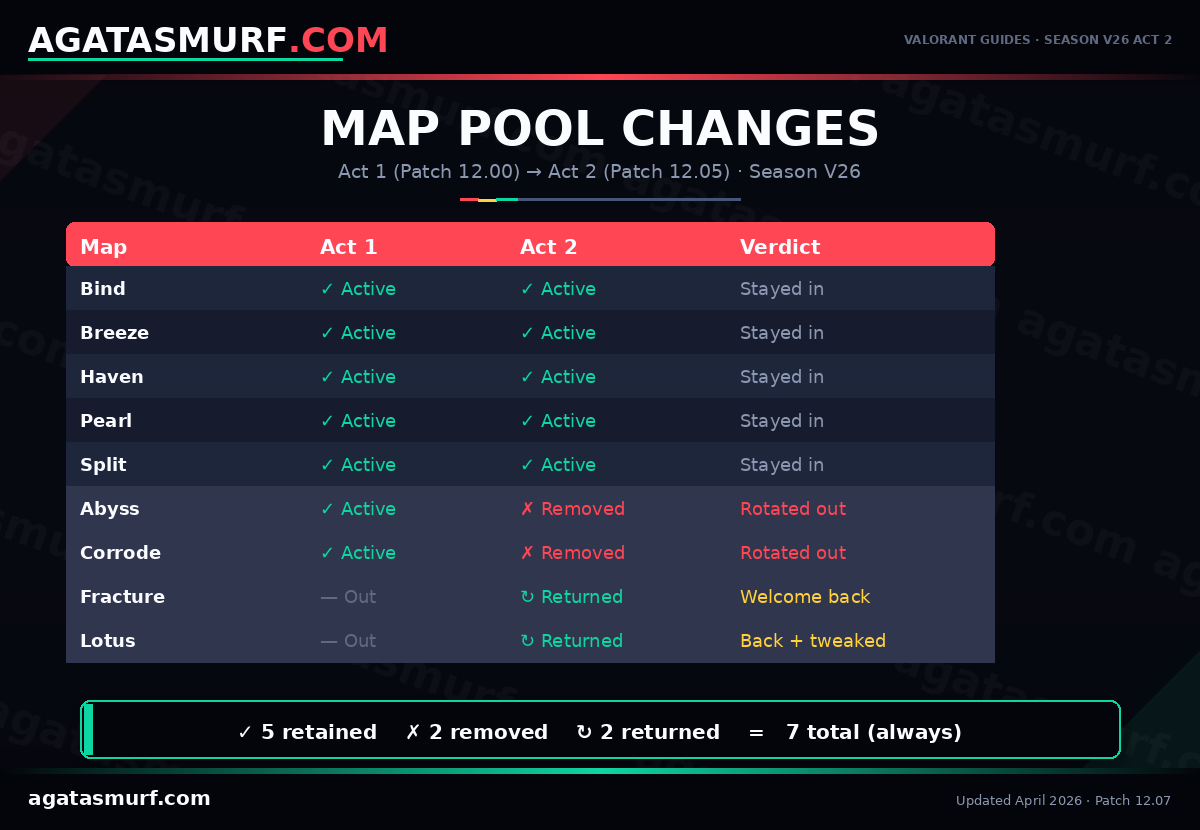
Abyss leaving hurts. The death-drop gimmick was genuinely fun and rewarded creative util, and it only got one Act of ranked. Putting money down that it comes back in Act 3. Corrode is a harder read. It arrived in 11.00 as the newest standard map, got one Act of play, got yanked. Player reception was mid. Riot probably wants to rework some choke points before handing it back to us.
Fracture returned untouched. No layout changes, no rework. Same H-shape, same zipline, same four ultimate orbs. For anyone who played Fracture before Patch 10.08 pulled it, this is a gift. Old Sova darts still land. Old Breach setups still work. Most players have forgotten them, which means free rounds are sitting there in solo queue for anyone willing to spend 20 minutes in custom lobbies remembering how the map plays.
Lotus got real changes. Details in the Lotus section below.
How Pros Are Vetoing the Act 2 Map Pool (VCT Americas Stage 1)
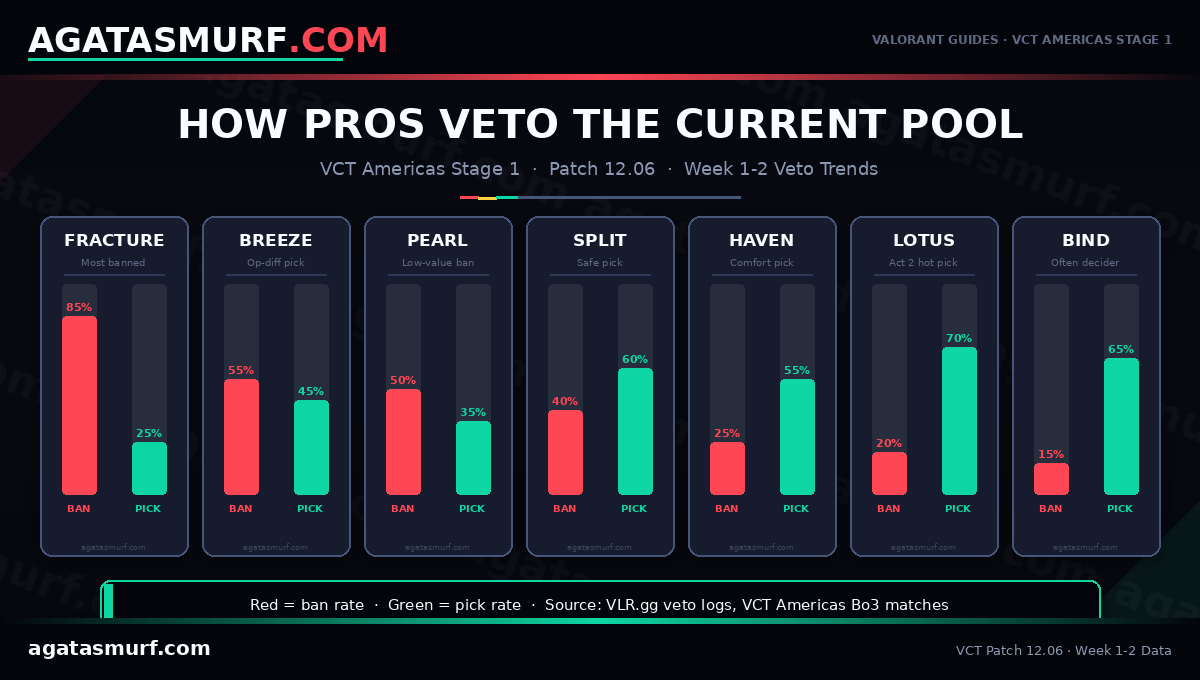
VCT Americas Stage 1 is happening right now at Riot Games Arena in LA. Started April 10, runs through May 24. Every match is Bo3 on Patch 12.06. Same 7 Valorant maps in rotation you get in ranked, same veto pool, which makes pro veto data the cleanest signal we have on what teams actually think is broken versus comfort territory.
Take the KRÜ vs Sentinels opener on April 10. KRÜ ban Fracture, Sentinels ban Pearl, KRÜ pick Lotus, Sentinels pick Breeze, KRÜ ban Haven, Sentinels ban Split, Bind is the decider. KRÜ took it 2-0. That veto pattern repeats across Week 1 almost every series. Fracture gets banned first the vast majority of the time. Lotus gets picked by attacker-inclined teams. Breeze is for rosters with a strong Op player (Sentinels, NRG, G2).
Here is the thing about pro bans and your ranked games. Pros do not ban Fracture because it is broken. They ban it because defender holds on Fracture are so locked down at Radiant level that nobody wants to play a coin-flip map with 3 ban slots available. At Plat and below, almost nobody can execute those pro-level defender anchors. Fracture is completely winnable for solo queue attackers who remember the old lineups. That skill gap across ranks is also why every map in the Valorant maps in rotation plays differently at Iron versus at Immortal. Take that knowledge and run with it.
Context from the VCT 2026 Kickoff earlier this year: Breeze was banned 19 times in China, Corrode also 19 times, Pearl 18 times. The global pro meta is narrowing hard around a 4-5 map core with 2-3 “comfort pick” floats. Regional splits matter too: Americas embraced Abyss and Split as most-played, EMEA let Breeze float as decider more often than anywhere else. Now that Abyss is out of the pool, Split has carried even more of the load.
Every Valorant Map in Rotation, Broken Down
Each map gets its own treatment below. The length and structure varies because they deserve different treatments. Breeze needs more detail because of the rework. Pearl gets less because there is less to say. Lotus gets the longest write-up because it actually got patched.
Bind
Two sites. No mid. Two one-way teleporters: Showers (A) to B Short, and Garden (B) to A Long. If you take nothing else from the Bind section, remember this: the TP activation sound is loud and gives away the rotate. Fake a TP, watch the defender peek for the sound, trade them. That one trick wins you at least 2 rounds per game in Gold and below.
Cypher is near-broken on Bind right now. Trapwires at TP exits are basically free intel every round. If my team does not have a Cypher or at least a Killjoy by agent select, I am already tilting. Omen is the default Controller because his smokes cover A Short and B Long independently and his teleport lets you reposition without using the TP yourself. Raze is underrated here. Satchel vaults into Hookah from B Long catch defenders completely off angle.
Viper on B site is still playable despite the 12.06 ult nerf. Skye flashes into Hookah or A Short destroy defenders holding traditional corners. Post-plant B site with a well-placed Molly is probably the highest win rate plant setup on Bind at Plat and below.
One note for Iron through Silver: Bind looks easy because there is no mid to think about. It is not. The TPs punish bad timing and good Cypher setups will end your round before you see a model. Stick with Omen or Brim smokes, listen for TP sounds, and play off your duelist.
Breeze
Breeze came back in Patch 12.00 with the biggest map rework Riot has ever done. Open spaces got tighter, wide corridors got more cover, defender rotation times got buffed. The result: it plays more balanced than pre-rework, but the Op still decides most rounds. Win rate data backs this up. Attack sits at 49.9%, defense at 51.4%. Basically even, but the defender holds a hair of edge because of the long sightlines.
The top win rate agent on Breeze right now is Killjoy at 54.3%, which surprised me. Her turret and util shut down the long pushes down A Hall and B Long without needing a dedicated Op. Clove (52.7%) and Viper (52.7%) tie for second. Jett is still at 52.6% but that number is misleading because Jett is only worth picking if you can actually use the Op. If you cannot, you are griefing.
At Gold and below, Breeze plays much more balanced than at Diamond+ because nobody at that ELO knows how to hold the long angles properly. You can get free picks by just W-keying A Hall with a Spectre. At Diamond+, Breeze becomes an Op differential match. If your team has one comfortable Op player, you stomp. If not, you lose.
Best agents for Breeze by rank: Iron to Gold run Killjoy plus a duelist (Raze, Neon, or Jett). Plat and up, get an Op in your comp and add Viper for her map-cutting wall. Post-plant B site with a Viper ult is basically a guaranteed round win if you defuse-deny correctly.
Fracture
Fracture is the weird one in the pool. Attackers spawn at both ends of the H and can push A or B from either direction. The zipline (A Rope) is the rotation highway. Four ultimate orbs, more than any other map in the Valorant maps in rotation, which means ults cycle faster and round pacing is chaotic by design.
Now for the part that messes with old Fracture tier lists. The map is defender-favored, not attacker-favored. Attack wins 48.2%, defense wins 51.4%, gap of 3.2% in the defender direction. The split-spawn theory reads great in the tutorial video and falls apart in actual matches because defenders just anchor both sites with util and punish attackers who overcommit. Same exact story as Haven.
Sova is putting up absurd numbers here (72% win rate on limited sample, take with salt but it is still elite). His Recon Darts across the H bounce cleanly and give defenders full info every round. Breach is second tier because his abilities punch through the thin walls that define every corridor. Neon rush B Arcade is one of the highest-win-rate site takes at Diamond and below because defenders cannot react to her speed.
Miks (the new Controller from Patch 12.05) is shaping up to be interesting on Fracture. His kit amplifies teammate utility, which plays well when your team is splitting spawns. Too early to call him meta but worth watching. The Patch 12.05 note also confirmed a bug fix where Deadlock’s Barrier Mesh could be used to float into the air by blocking Fracture’s attacker spawn ziplines. That exploit is dead now.
If your team cannot coordinate a split, do not try. Solo queue Fracture is about picking one side and winning that side hard.
Haven
Three sites. Everyone says this means defenders get stretched thin. The win rate data says the opposite. Haven is defender-favored at 52.1% to 48.9%, a 3.2% edge. Brimstone of all agents leads the map at 63.9% win rate because his central smoke anchor covers rotations to any of the three sites faster than any other Controller.
Mid and Garage control is the whole game. Garage connects to all three sites, so whoever holds Garage dictates rotations. Teams that ignore mid and stack CT spawn hand attackers free rotation windows. At Silver and Gold nobody plays mid aggressive enough, which is why Haven feels attacker-stomp-y at those ranks. At Plat and up, defenders properly contest mid and the win rates flip in their favor.
Agent picks by rank: Iron to Silver lock in Reyna or Neon because the isolated corridor duels favor frag-hungry duelists. Gold to Plat shift to Omen plus Killjoy or Brimstone plus Sova. Diamond+ see double Controller with Brim and Omen or Astra to lock down cross-site smokes.
If you are climbing through mid-ELO, learning one Sova dart lineup per site on Haven is probably the single highest-EV thing you can practice this Act. The dart bounces off C Long, A Short, and the Garage walls are predictable enough that a cheat sheet gives you a measurable edge.
Lotus
Lotus got real changes in 12.05 and the patch notes spell them out exactly. Riot’s stated goal was to reduce weapon spam when the barrier drops and to help attackers fight for Rubble more effectively. Here is what actually changed:
- Attacker Lobby wall thickened: no more wall penetration off barrier drop. Defenders can no longer just headshot-spam through the wall during the opening seconds.
- Jump-up to Vines moved: gives attackers a better angle out of Lobby and avoids immediate utility dumps.
- Tree room wall reinforced: removes another wall penetration spot defenders were abusing.
- Extra room outside A-site stairs: lets defenders play further back from Rubble, which changes A-site retake angles substantially.
What this means for ranked: A-site attack executes got easier. Defender A-site holds got cleaner. The win rate data shows Lotus is now just about balanced at 50.6% attack to 49.5% defense, which is about as even as it gets in this game.
The three sites, rotating stone doors, and breakable A-Link wall are all still here. Door timing is the single highest skill expression on Lotus. Trigger a door as an enemy sprints through it to deny their rotate. Bait someone into a door about to close and you get a free pick. Learn the audio cues (there are three distinct sounds depending on door state).
Viper still wins on Lotus even after the 12.06 ult nerf. Her Wall cuts B Main or C Main in half, making 3-site defense genuinely manageable. Killjoy Lockdown on C site is disgusting because the site geometry gives defenders barely any retreat space. Fade’s Haunt covers more territory on a 3-site map than on any 2-site map, so her intel scales harder here. KAY/O is also putting up strong numbers on Lotus, likely because his suppression ability hard-counters Viper and Cypher holds.
Miks is a sleeper pick for Lotus. His support kit pairs well with the door-defined geometry because he can amplify a teammate’s util through tight choke points where the doors dictate timing.
Pearl
Pearl has no gimmicks. No teleporters, no doors, no ziplines, no death drops. Just geometry and gunplay. It is one of the fairest maps in the current pool from an attacker/defender balance standpoint and also one of the least loved. Nobody hates Pearl. Nobody loves Pearl. It just exists.
Mid Market is the whole round. Whoever wins Mid Market in the first 30 seconds controls rotations. Sova Recon Dart through Mid Shops into CT Spawn is one of the cleanest info plays in the current rotation because Pearl’s flat geometry makes dart bounces extremely predictable. There is a one-bounce dart from default attacker spawn that covers half of CT every single round.
Chamber holding Mid with an Op is still a classic for a reason. Omen smoke into A Art followed by his teleport is a free pick nine out of ten attempts. Fade’s Seize ability is elite for cutting defender rotations through Mid Connector. Reyna is the pub-stomp pick at lower ranks because Pearl produces so many isolated corridor 1v1s that her dismiss-and-heal loop eats.
Pearl was benched for 420 days at one point, the longest any map has ever been away from Valorant’s ranked rotation. Came back at some point, stuck around since. Not a fun map, not a hated map. Across all 7 Valorant maps in rotation right now, Pearl is the cleanest aim check. Nothing fancy, just gun fights.
Split
Split is the verticality map. Ropes at Mid, ropes at A Main, and “Heaven” angles on both sites. If you cannot use verticality, Split will feel like every defender is cheating. If you can, Split is one of the easier maps to hold CT side because angles compound. The numbers back this up hard: Split runs a 48.1% attack to 53.3% defense split, the biggest defender edge of any map in the current pool at +5.2%. Sova leads Split at 62.7% win rate because his dart clears through Mid Vent and A Rafters give you info on angles you cannot physically peek.
Cypher Trapwires at A Ramps and B Alley are S-tier setups. Sage Wall is more valuable on Split than on any other map in the rotation because the narrow entrances mean one wall can lock down a full site push. Raze satchels vault over corners that would normally kill you, opening angles that defenders do not clear. Omen teleport to Mid Top is a cheeky rope-contest play that works more often than it should.
B site retakes on Split are probably the most painful retakes in the entire current pool. The defender base is tiny and retakes usually require a perfect combo of smoke, flash, and entry kill. If you lose B control at any rank, commit to saving and run it back next round. Chasing a bad B retake is the fastest way to lose the half.
Main Iron through Silver agent to run: Phoenix or Reyna on B site side with a Sage for walls. Gold+ shift to Cypher for info and Raze for entry. Diamond+ see Chamber plus Cypher stacks for the long Heaven holds.
Valorant Map Callouts Cheat Sheet (All 7 Active Maps)
Callouts are the short position names teammates use over comms. Wrong callout equals wrong info equals dead teammate. Here is every key callout across the current Valorant maps in rotation.
| Map | A Side | B Side | Mid / Connector |
|---|---|---|---|
| Bind | A Short, A Long, A Lamps, Bath, A Site | B Long, Hookah, B Short, B Site | Showers TP, Garden TP, CT Spawn |
| Breeze | A Hall, A Pyramids, A Cave, A Site | B Long, B Elbow, B Stairs, B Site | Mid, Mid Nest, Mid Pillar, Beach |
| Fracture | A Dish, A Hall, A Drop, A Site | B Arcade, B Generator, B Tunnel, B Site | A Rope, Canteen, Attacker Spawn L/R |
| Haven | A Long, A Short, A Box, A Site | B Entrance, B Garage, B Site | C Long, C Short, C Site, Mid, Courtyard |
| Lotus | A Main, A Root, A Link, A Rubble, A Site | B Main, B Stairs, B Site | C Main, C Waterfall, C Site, Upper, Mound |
| Pearl | A Main, A Link, A Art, A Flowers, A Site | B Main, B Green, B Tunnel, B Site | Mid Market, Mid Shops, Mid Connector |
| Split | A Ramps, A Rafters, A Screens, A Heaven, A Site | B Alley, B Elbow, B Heaven, B Site | Mid Top, Mid Vent, Mid Ropes, Mail |
A few gotchas that trip new players up across the Valorant maps in rotation: “A Rope” on Fracture always means the zipline, never the site. “Heaven” exists on both A and B on Split, so always prefix with the site letter. “Short” on Haven is ambiguous because Haven has three sites, so say A Short or C Short explicitly. On Lotus, “Upper” is the raised connector between C Main and Mound, not C Waterfall.
Best Plant Spots for Each Valorant Map in the Rotation
Plant position decides post-plant rounds more than most players think. Not all spots are equal. vstats.gg tracks plant heatmaps per map per rank, and the same handful of spots consistently outperform the rest at every skill level. Top win rate plants per map, from V26 Act 2 data:
| Map | A Site Best Plant | B Site Best Plant | C / Third Site |
|---|---|---|---|
| Bind | Default (center of site) | Back B (near Hookah) | N/A |
| Breeze | Bench / Default | Back Site (near Tunnel) | N/A |
| Fracture | Default (A Dish side) | Arcade corner | N/A |
| Haven | Back A (default) | Tight B (back wall) | C Default |
| Lotus | Default A (post-12.05 change) | Back B (behind stairs) | C Default (hard plant for retake) |
| Pearl | Default A (near Art) | B Link side | N/A |
| Split | Plant for Heaven (watch from Main + Screens) | Plant for Heaven + Main | N/A |
Two things about this you should actually care about. The Lotus A-site plant meta flipped completely in 12.05. Pre-patch everyone planted behind Breakable or Link cover because defenders had to break a wall to clear the plant. Post-patch those spots are disabled. Default A plants are the new meta. If you were running old Lotus A lineups from before March, throw them in the trash.
On Split, pro Juliana “showliana” Maransaldi from Dignitas has said for years that planting for Heaven plus Main on B is the top plant because you can watch from Heaven, Hell, and Garage at the same time. It is more exposed than safer plants. The post-plant coverage is unbeatable though. On A, planting for Heaven (watched from Main and Screens) is the equivalent. Both spots cost a little entry risk for a lot of defend value.
Rotation Speed Comparison: Which Valorant Maps in Rotation Rotate Fastest?
Rotation speed is how long a defender needs to move from one site to another after attackers commit. Matters more than most players realize. Maps with fast rotations reward defenders who read the round early. Slow-rotate maps punish defender reads because retakes cost more if you guess wrong. Rough numbers for the Act 2 pool, measured site-to-site in seconds:
| Map | Rotation Type | Avg Site-to-Site Time | Implication |
|---|---|---|---|
| Bind | Teleporter-based | ~8-10 sec (via TP) | Fake TPs are high-EV |
| Fracture | Zipline / Canteen | ~12-15 sec | Defender pre-rotate wins rounds |
| Lotus | Doors + Upper | ~14-18 sec | Door denies matter more than rotates |
| Haven | Garage + Mid | ~15-18 sec | 3-site setup burns rotate budget |
| Split | Mid + Ropes | ~16-20 sec | Slow rotations favor aggressive defense |
| Pearl | Mid Connector | ~18-22 sec | Mid control = rotation control |
| Breeze | Mid + long corridors | ~20-25 sec | Slowest rotates, reward coordinated fakes |
Practical angle on this: on fast-rotate maps like Bind and Fracture, fakes actually work because defenders can snap back quickly if you do not fully commit. On slow-rotate maps like Breeze and Pearl, one well-sold fake can lock a defender on the wrong site for the whole round. Below Gold, almost nobody respects fakes on Breeze at all. Going B with 4 players while one person lurks A is one of the highest-win-rate executes at that ELO. Abuse that.
Maps NOT in the Current Valorant Rotation (Act 2)
Five maps are benched this Act. They exist, they work, they are fully playable in Unrated, Swiftplay, Escalation, Spike Rush, Deathmatch, and Custom games. Just not part of the Valorant maps in rotation for ranked, Premier, or competitive Deathmatch queue right now.
- Abyss: Out as of Patch 12.05. Death-drop map with no outer walls. Likely returns Act 3 since it only sat out one Act and got solid reception.
- Ascent: Out since late 2025. The classic Venice map with mid-control doors. Most overdue map for a return.
- Corrode: Out as of Patch 12.05 after a single Act. Newest standard map (added 11.00). Riot likely reworking choke points.
- Icebox: Out since mid-2025. Vertical ziplines and stacked A-site fights. Fans are tired of waiting.
- Sunset: Out since Patch 12.00 (Act 1 start) after 254 days of active rotation. The LA map.
If one of these is your main, Deathmatch is the best place to keep your reps sharp. DM queues use all 12 standard maps regardless of rotation status, and the pace is close to real ranked without the MMR stress.
How Valorant Picks Which Map You Load Into
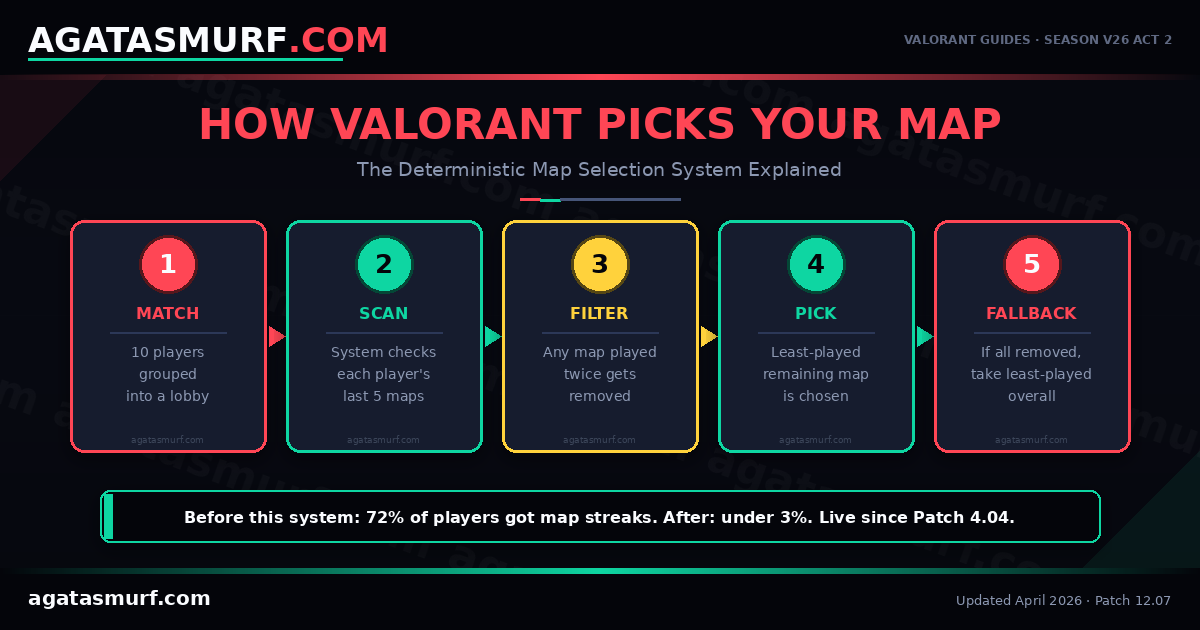
You do not get a random map from the 7 Valorant maps in rotation. Riot uses a deterministic selection system. After 10 players get matched, here is the actual process:
- The system looks at each player’s last 5 maps in that queue.
- Any map a player has played twice in those 5 games is removed from the candidate pool.
- Of what remains, the system picks the least-played map across all 10 players combined.
- Edge case: if all 7 maps get knocked out by the “played twice” rule (rare), the system ignores the filter and just picks the overall least-played map.
This went live in Patch 4.04. Before it, 72% of players got map streaks across their last 5 games. The deterministic system cut that hard. Same-map back-to-back is now basically impossible unless your queue history is very lopsided.
One detail most guides miss: the system runs per queue. Your Competitive and Unrated histories are tracked separately. If you ground 4 hours of Unrated on Breeze yesterday, that does not affect your Competitive algorithm today. This is why some players “feel” like they get the same map in ranked despite grinding variety in Unrated. The algorithm does not know or care.
Why Only 7 Valorant Maps in Rotation at a Time?
Riot lead map designer Joe Lansford laid it out in 2022: seven is the balance point. Fewer maps and the meta stales. More and new players drown trying to learn everything at once.
The number also cleans up pro play mechanically. Best-of-three and best-of-five series get even ban structures at 7 maps. Each team bans without ever having to replay the same map in a series. Bump the pool to 8 or 9 and the ban phase math breaks.
Practically, 7 also gives Riot room to yank maps for rework without leaving a hole. Breeze sat out 576 days before its 12.00 rework and return. During that span, the pool stayed fully populated with 7 other maps. This rigidity is why the 7-map rule never changes even as Valorant’s total map count grows.
Ranked Climbing Tips for the Act 2 Valorant Maps in Rotation
The current pool has two 3-site maps (Haven, Lotus) out of 7, which is on the higher side historically. Controllers are more valuable this Act than average.
Omen fits every single one of the Valorant maps in rotation right now. He is a safe default lock if your team is griefing the comp pick. Brimstone in particular spikes on Haven at 63.9% win rate, which is stupidly high for a non-meta pick. If your team already has a Controller and you are flex, Brim on Haven is a free 5-10 LP gain equivalent.
Viper is still S-tier on Lotus (wall plays) and usable on Breeze for same-reason plays despite the 12.06 ult nerf. Killjoy is quietly the best Breeze pick at 54.3% and most people still do not know this.
If Fracture is not in your ranked warmup queue, add it. The map returned in 12.05 with zero changes, so every old lineup still works, but most players have not touched the map in almost a year. You get an edge on Fracture just by remembering basic Sova darts.
If you want to grind specific maps without wrecking your main MMR, picking up a fresh Valorant smurf account is a clean way to practice Fracture or Lotus in ranked without baggage. Act 2 is also when returning players flood back, so solo queue is messier than usual and a fresh rating curve helps.
A Quick History of the Valorant Map Rotation System
Quick origin story since some new players ask. Valorant launched in June 2020 with four maps total: Bind, Haven, Split, and Ascent. No rotation, no bench. You could queue anything, any time. Map selection was straight random which is why 72% of players got stuck on repeat maps across their last 5 games.
Patch 1.08 switched the system to pseudo-random. Still flawed. Patch 4.04 rolled out the deterministic system we have today. The actual concept of rotating maps in and out of ranked did not exist until Patch 5.00 in June 2022 when Pearl launched as the 8th map. That is when Riot picked 7 as the permanent pool size, and Split drew the short straw and became the first map ever benched.
From 5.00 through Patch 10.00 in January 2025, Riot swapped maps whenever they felt like it. Some Acts had big changes, some had none. Since 10.00, the pool updates every Act on a fixed cadence. Two swaps max per Act, sometimes zero. The consistency is new and players seem to actually like it.
All 12 Valorant Standard Maps (April 2026)
Every standard map in Valorant, when it released, and whether it is in the current pool. Does not include Team Deathmatch maps or The Range.
| Map | Sites | Released | Setting | In Rotation? |
|---|---|---|---|---|
| Bind | 2 | Beta (June 2020) | Morocco | Yes |
| Haven | 3 | Beta (June 2020) | Bhutan | Yes |
| Split | 2 | Beta (June 2020) | Tokyo | Yes |
| Ascent | 2 | Patch 1.0 (June 2020) | Venice | No |
| Icebox | 2 | Patch 1.10 (Oct 2020) | Bennett Island, Russia | No |
| Breeze | 2 | Patch 2.08 (April 2021) | Tropical island | Yes |
| Fracture | 2 | Patch 3.05 (Sept 2021) | New Mexico | Yes (returned 12.05) |
| Pearl | 2 | Patch 5.00 (June 2022) | Lisbon (underwater) | Yes |
| Lotus | 3 | Patch 6.00 (Jan 2023) | Western Ghats, India | Yes (returned 12.05) |
| Sunset | 2 | Patch 7.04 (Aug 2023) | Los Angeles | No |
| Abyss | 2 | Patch 8.11 (June 2024) | Endless chasm | No |
| Corrode | 2 | Patch 11.00 (Oct 2025) | Mont-Saint-Michel, France | No |
When Does the Next Valorant Maps in Rotation Update Happen?
Act 3 lands next. Based on the 2-month cadence Riot has been running, bet on late May or early June 2026. The patch notes for the first Act 3 patch will spell out what rotates. Keep an eye on the Maps section of those notes.
My personal guess on what comes back, based on how past rotations have looked: Abyss is the slam-dunk return candidate. It was well-received, only sat out one Act, and has a unique mechanic the pool is missing right now. Ascent is overdue after being gone since late 2025. Corrode likely stays benched if the rework rumors are real. Fracture and Lotus just came back so they are both safe to stick around for Act 3 at minimum.
This video from Riot covers how the rotation system and selection process work if you want to go deeper on the mechanics:
For more on the current meta, check the Valorant agent tier list to see which agents are putting up the best numbers this Act. Miks just launched in 12.05 and is shifting the Lotus and Fracture comps in particular.
If lag or movement jank is messing up your games on any of these maps, the Valorant desync fix guide covers every network setting that matters for stable ranked play. The official Valorant maps page also updates whenever Riot reworks a map or changes the pool.
FAQ: Valorant Maps in Rotation
What are the Valorant maps in rotation right now?
Seven maps in ranked as of Patch 12.05 (live since March 17, 2026): Bind, Breeze, Fracture, Haven, Lotus, Pearl, Split. Abyss and Corrode got rotated out. Patch 12.07 on April 14 left the pool untouched so this is still current.
How many maps are in the Valorant competitive pool?
Always seven. Riot’s lead map designer Joe Lansford locked in that number back in 2022 as the balance point between enough variety to keep things interesting and not overwhelming newer players.
How often does the Valorant map rotation change?
Every Act, which is roughly every 2 months. This cadence kicked in with Patch 10.00 in January 2025. Before that Riot updated the pool whenever they felt like it. Now the changes ship with the first patch of each new Act.
Which maps got removed from Valorant in Season V26 Act 2?
Abyss and Corrode. Both got pulled when Patch 12.05 dropped on March 17, 2026. Still playable in Unrated, Swiftplay, Spike Rush, and Escalation if you want to keep your reps up on them.
Can I play Valorant maps that are not in rotation?
Yeah. Benched maps stay in Unrated, Swiftplay, Spike Rush, Escalation, Deathmatch, and Custom games. Only Competitive, Premier, and Deathmatch queues use the 7-map rotation.
How does Valorant decide which map you load into?
It is not random. Once 10 players match, the system checks each player’s last 5 maps, tosses any map a player has already played twice in that window, then picks the least-played of what is left. That is why same-map back-to-back almost never happens.
Is Fracture back in Valorant competitive for 2026?
Yes. Fracture came back with Patch 12.05 at the start of V26 Act 2 in March 2026. It had been on the bench since Patch 10.08 so roughly a year of competitive absence.
What changed on Lotus in Patch 12.05?
Four specific A-side changes. Attacker Lobby wall got thicker to kill wall penetration off the barrier drop. Jump-up to Vines moved to give attackers a better chance to fight for Rubble. Wall outside Tree room got reinforced. And extra space got added outside A-site stairs so defenders can hold further back from Rubble. Rotating stone doors and the breakable A-Link wall are unchanged.
For more Valorant guides, check the article on reporting smurfs in Valorant or grab a ranked ready Valorant account to grind Act 2 from a clean slate.
Last updated: April 18, 2026. Win rate data sourced from vstats.gg and metabot.gg API pulls through April 17, 2026. Patch notes verified against Valorant Patch 12.05 and 12.07 official releases.
