Every League of Legends Dragon, Their Buffs, Souls, and Map Changes
Six elemental drakes plus one Elder Dragon. That’s what League of Legends dragons look like on Summoner’s Rift right now, and honestly, these things decide more games than most players realize. On Patch 26.7, whoever controls the pit usually controls the match. Stacking buffs, permanent soul effects, Elder’s execute that just deletes people below 20% HP. It all adds up fast.
I’ve been tracking my ranked games this season and drake control correlates with wins way more than KDA does. Soul team wins something like 85-90% of games (based on community data from League of Graphs and similar tracking sites). Riot keeps nerfing soul effects and it barely moves that number. Here’s my full rundown on every League of Legends dragon, the actual numbers behind each buff, spawn mechanics, and the stuff that matters when you’re sitting there at 19 minutes wondering if you should contest or just take Herald topside.
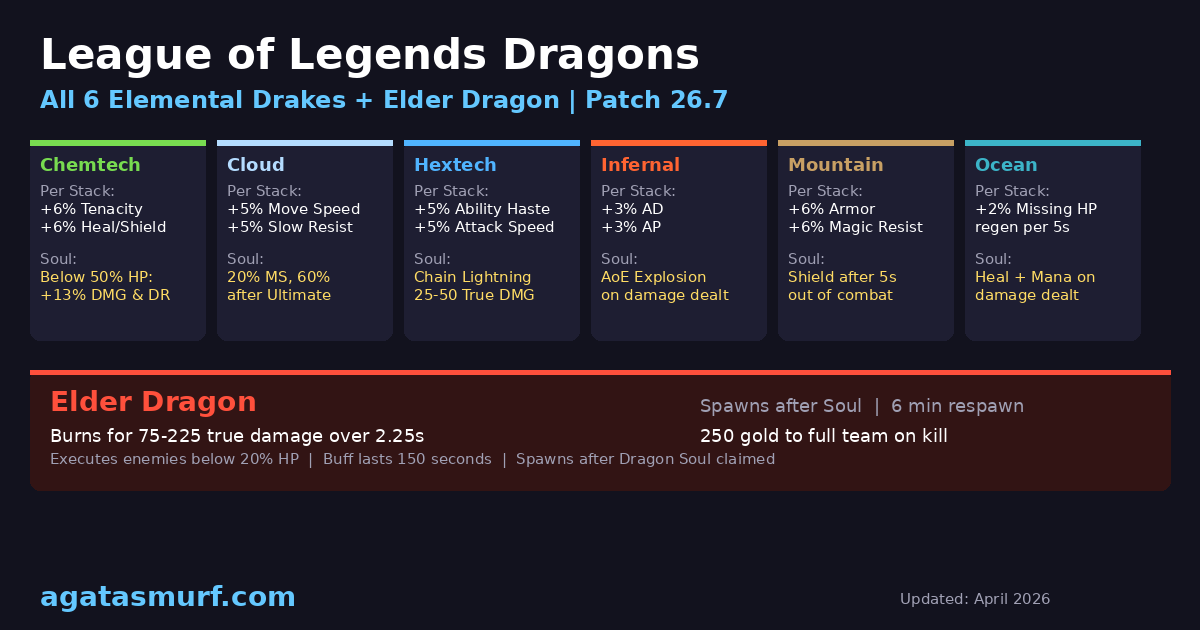
League of Legends Dragons: Quick Reference Table
I keep a version of this league of legends dragons table bookmarked on my phone for mid-game checks. Copy it, screenshot it, whatever works. Just know the numbers.
| Drake | Per-Stack Buff | Soul Effect (4 stacks) | Rift Change |
|---|---|---|---|
| Infernal | +3% AD and AP | AoE explosion on damage dealt | Walls break, Infernal Cinders spawn |
| Mountain | +6% Armor and MR | Shield after 5s out of combat | New rock walls and chokepoints |
| Ocean | +2% missing HP regen/5s | Heal + mana on damage dealt | Extra brush and Honeyfruits |
| Cloud | +5% MS and slow resist | 20% MS, 60% after ultimate | Speed zones near buffs/pit |
| Hextech | +5% ability haste and AS | Chain lightning 25-50 true DMG | Hex-gates for teleporting |
| Chemtech | +6% tenacity and heal/shield | +13% DMG and DR below 50% HP | Mutated jungle plants |
| Elder | N/A (spawns after Soul) | Burn + execute below 20% HP (150s) | N/A |
How League of Legends Dragons Spawn and Scale
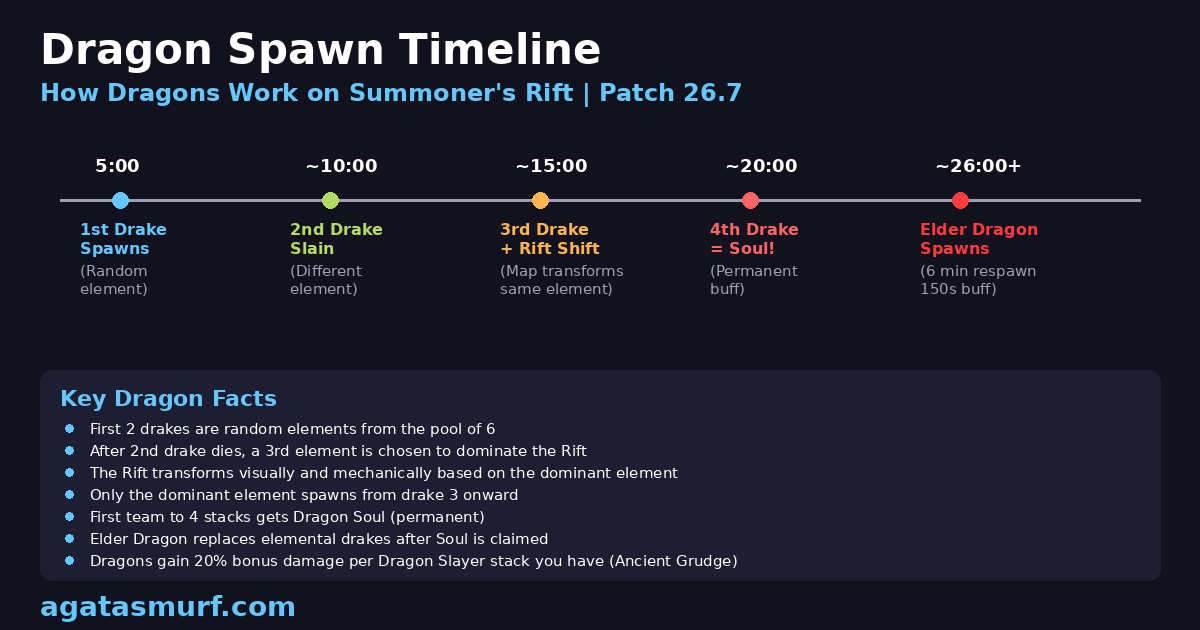
The first drake spawns at 5:00 on the game clock. After it dies, the next one shows up exactly 5 minutes later. The first two drakes are always random elements pulled from the pool of six: Chemtech, Cloud, Hextech, Infernal, Mountain, and Ocean. You can see which element is coming by checking the icon on the dragon pit wall and the minimap timer.
Once the second drake is killed, something bigger happens. A third element gets chosen (one that hasn’t appeared yet), and this element takes over the map. The terrain around dragon pit, the buff camps, and parts of the jungle all change based on this dominant element. From the third drake onward, only that element spawns.
When one team hits 4 total Dragon Slayer stacks, they claim Dragon Soul, a permanent buff that sticks for the rest of the game, even through death. After that, elemental drakes stop spawning entirely. The Elder Dragon takes their place with a 6-minute respawn timer.
One thing a lot of players miss: dragons get harder to kill the more stacks your team has. There’s a passive called Ancient Grudge that gives each drake 20% bonus damage and 7% damage reduction per Dragon Slayer stack on your team. So by the time you’re fighting for your 4th drake, the thing hits 80% harder and takes 28% less damage. That’s why fourth drake fights feel so sketchy even when you’re ahead.
Dragon Combat Stats
All league of legends dragons share certain combat properties. They’re immune to crowd control (except Bard ult and Kindred ult), they can’t have their stats modified, and their basic attacks deal bonus physical damage equal to 5% of the target’s current health with 30% armor penetration built in. When engaged, they knock back everyone within 550 units.
| Stat | Drake 1 and 2 | Drake 3+ (after Rift Shift) | Elder Dragon |
|---|---|---|---|
| Base HP | 5,730 (+380/level) | 9,230 (+380/level) | 6,400 (+290/min) |
| HP Regen | Standard | Standard | 250/sec |
| Armor | 21-41 (varies by type) | Same | 120-180 |
| Magic Resist | 30-50 (varies by type) | Same | 70-113 |
| Respawn Timer | 5 minutes | 5 minutes | 6 minutes |
| Gold | 25 (killer only) | 25 (killer only) | 250 (full team) |
| XP | 150-330 (nearby allies) | 150-330 (nearby allies) | 650-830 (nearby allies) |
That 250/sec HP regen on Elder is wild. Baron Nashor literally can’t outdamage it. So if you ever wondered who wins in a Baron vs Elder 1v1, now you know.
What Changed for Dragons in 2026 Season One
The 2026 Season One “For Demacia” update (full patch notes here) brought some relevant changes to how objectives work overall. Riot removed Atakhan (the top-side voidborn boss from late 2025) and Feats of Strength entirely. The idea was to cut down on objective overload so teams stop pulling their hair out trying to contest 4 different neutral objectives at once.
With Atakhan gone, dragon stacking is back to being the primary bot-side win condition alongside turret pressure. Baron also returned to its 20-minute spawn, which means the timing window between third/fourth drake and Baron is tighter than before. If your team is on 3 drake stacks around the 19-minute mark, you need to decide fast: do you set up for soul, or do you pivot to Baron at 20? In my games, I’ve found that teams who tunnel on soul and ignore the Baron timer often lose the map even with soul in hand.
Riot also changed Elder Dragon’s effective HP by about 20% in Patch 26.1, and shifted its comeback XP from quadratic to linear scaling. The comeback XP still goes up to 2x at a 4-level deficit, so losing teams that manage to steal Elder get a nice XP injection on top of the broken buff.
All 6 League of Legends Dragons and What They Give
Each of the league of legends dragons gives a stacking buff when killed, plus a unique soul effect at 4 stacks. Here’s what every elemental drake actually does, with the numbers you need.
Infernal Drake
Infernal is the pure damage drake. Killing one grants your whole team 3% bonus AD and AP per stack (so 3/6/9/12% at max stacks). The numbers look small early, but they scale multiplicatively with your items. A fed mage with 3 Infernal stacks hits noticeably harder than one without.
Infernal Soul: Your attacks and abilities trigger an AoE explosion around the target, dealing bonus adaptive damage that scales with AD, AP, and bonus health. This soul turns any carry into a teamfight monster because the splash damage hits everyone nearby.
Infernal Rift: Walls around the jungle break apart, opening new flanking routes. Infernal Cinders spawn randomly around the map, and picking them up gives you a burst of movement speed plus a small stack of adaptive stats. The losing team gets more cinders spawning on their side, which is Riot’s way of throwing a bone to the team behind.
Mountain Drake
Mountain is the tank’s best friend. Each kill gives 6% bonus armor and magic resist per stack. At 4 stacks you’re looking at 24% extra resistances for everyone on your team. A Cho’Gath with 4 Mountain stacks? Good luck killing that. Even your ADC gets surprisingly tanky with this buff.
Mountain Soul: You stop taking damage for about 5 seconds and a shield pops up, scaling off bonus AD, AP, and bonus health. It comes back every time you drop out of combat. Sneaky good because you walk into every fight with a free buffer of HP that the enemy has to chew through first.
Mountain Rift: Extra rock formations spawn around the jungle and dragon pit, creating new walls and chokepoints. These can be used for surprise flanks or to block off enemy paths during objective fights.
Ocean Drake
Ocean keeps you alive between fights. Every stack gives 2% missing HP back every 5 seconds when you’re out of combat. Sounds small on paper, but try laning against someone with 2 Ocean stacks. They eat a bad trade, walk behind turret for 15 seconds, come back with half the HP recovered. Annoying as hell to play against.
Ocean Soul: Damaging enemies heals your champion and restores mana over 4 seconds. The healing scales with bonus AD, AP, and bonus health. Against non-champions, the heal is reduced to 30% effectiveness. This soul turns extended fights in your favor because your team just refuses to die.
Ocean Rift: Extra brush grows in the jungle and around dragon pit. Additional Honeyfruits spawn near both bases and along the river, giving more sustain options. The extra brush creates ambush spots that weren’t there before.
Cloud Drake
Cloud drake gives 5% slow resist and 5% out-of-combat movement speed per stack. By itself, one stack barely matters. But stacked up, your team rotates across the map way faster than the enemy.
Cloud Soul: Gain 20% bonus movement speed out of combat, jumping to 60% for 6 seconds after casting your ultimate on a 30-second cooldown. Cloud Soul was recently nerfed because it was statistically the best performing soul in Diamond+ games. The movement speed after ulting is still ridiculous, though. Engage champions like Malphite, Hecarim, and Nocturne become nearly impossible to react to.
Cloud Rift: Air currents appear around buff camps and the dragon pit, granting 20% bonus movement speed (35% if out of combat) to anyone standing in them. Extra Scryer’s Blooms also spawn near base gates.
Hextech Drake
Hextech grants 5% ability haste and 5% attack speed per stack. Both stats are valuable on almost every champion. The ability haste is great for mages and supports, while the attack speed helps ADCs and on-hit bruisers. It’s a universally useful drake.
Hextech Soul: Every time you hit someone, a lightning bolt zaps them and chains to up to 3 nearby enemies. Deals 25-50 true damage based on your level, applies a 45% slow for melee (35% for ranged) that fades over 2 seconds. The slow scales off your bonus AD, AP, and health too. In a 5v5, these chain zaps just stack up and the enemy team can barely move.
Hextech Rift: Pairs of hex-gates spawn near both bases and near the baron and dragon pits. Champions can channel for 0.75 seconds to warp to the other gate, becoming untargetable during the dash. These gates completely change how teams rotate and flank.
Chemtech Drake
Chemtech is the anti-CC drake. You stack 6% tenacity and 6% heal/shield power per kill. Four stacks means 24% tenacity stacked on top of your Mercury’s Treads or Legend: Tenacity rune. If you’ve ever been chain-stunned by a Leona/Nautilus bot lane and thought “I wish CC lasted less,” this is the drake for that.
Chemtech Soul: Drop below half HP and you get 13% extra damage plus 13% damage reduction. Riot bumped this up from 11% because Chemtech Soul was the worst performer of the bunch. Still feels a bit niche, honestly. Works great on champs that want to be low HP anyway (Aatrox, Olaf, Swain), but on a squishy mage it barely matters because you’re already dead before the buff kicks in.
Chemtech Rift: Jungle plants mutate with enhanced effects. Honeyfruits gain a small shield. Blast Cones have bigger radius. Scryer’s Blooms reveal a wider area. These changes aren’t as flashy as hex-gates or infernal cinders, but the upgraded plants give meaningful advantages during jungle skirmishes.
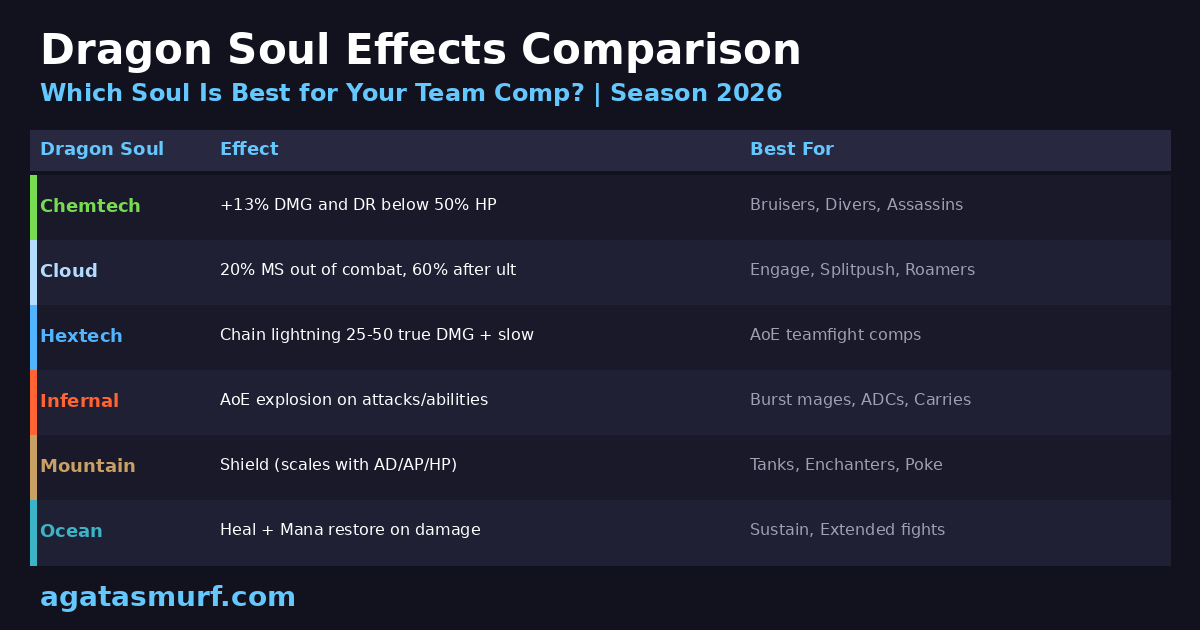
League of Legends Dragons Soul Tier List (Patch 26.7)
Which soul you want depends on what your team looks like and what the meta favors. Here’s my Patch 26.7 ranking, based on win rate data from community trackers and my own ranked experience this split:
| Tier | Dragon Soul | Why |
|---|---|---|
| S | Cloud | Movement speed is the hardest stat to answer. Even after nerfs, Cloud Soul gives your team insane map control and engage potential. |
| A | Hextech | Chain lightning with built-in slow shuts down teamfight positioning for the enemy team. Strong in any comp. |
| A | Infernal | Free AoE damage on every ability and auto. Carry-focused comps love this. |
| B+ | Mountain | The shield is strong, but it needs 5s out of combat to refresh. Gets less value in constant-fight scenarios. |
| B | Ocean | Great for sustain comps, but burst damage ignores the healing entirely. Weaker into high-burst metas. |
| B | Chemtech | Only activates below 50% HP. Niche. Riot keeps buffing it, which tells you it’s still the weakest overall. |
Elder Dragon: The Strongest of All League of Legends Dragons
Elder Dragon is the scariest of all league of legends dragons. It only spawns after one team claims Dragon Soul, and its buff, Aspect of the Dragon, lasts 150 seconds (or until you die).
What makes Elder so terrifying is the execute. Every attack and ability you land burns enemies for 75-225 true damage over 2.25 seconds (scales with game time). And if you damage any enemy champion while they’re below 20% HP, they get executed instantly. No counterplay except staying above that threshold or avoiding combat entirely. The execute has a 2-second per-target cooldown across all holders, so your whole team can’t chain-execute one person, but it still ends teamfights fast.
Elder Dragon itself is tanky. It has base HP of 6400 plus 290 per minute, 120-180 armor, and 70-113 magic resist. Its HP regen sits at 250 per second, which is so high that even Baron Nashor can’t outdamage it. You need your team to commit to this fight, not just poke at it.
How League of Legends Dragons Change the Map (Elemental Rifts)
Half the fun of league of legends dragons is the map transformation. The Elemental Rift kicks in after the second drake dies and the third element locks in. The map shifts visually and mechanically depending on which element takes over. I covered each rift change under the individual drakes above, but here’s a cheat sheet:
| Rift Type | Key Map Change | Strategic Impact |
|---|---|---|
| Chemtech | Mutated jungle plants with enhanced effects | Better sustain and vision around objectives |
| Cloud | Air currents give MS near buffs and pit | Faster rotations and objective setup |
| Hextech | Teleport gates near bases and pits | Flanking and fast base-to-objective movement |
| Infernal | Walls destroyed, Infernal Cinders spawn | New flanking paths, extra stats for losing team |
| Mountain | Rock formations create new terrain | New chokepoints, ambush spots |
| Ocean | Extra brush and Honeyfruits | More sustain options, ambush-heavy jungle |
Objective Control: What Actually Wins Games
Knowing what each of the league of legends dragons does is only half the picture. The other half is knowing when to fight for them, when to trade, and when to just let one go. Here are the things that actually matter from my experience in ranked.
Red Side vs Blue Side Advantage
Red side has a natural advantage for drake control because the dragon pit entrance faces red team’s jungle. Your bot lane has a shorter walk, your jungler has easier access, and you can drop a Control Ward behind the pit wall without face-checking enemy territory. Blue side, on the other hand, has to approach through the river, which gives less vision and more risk of getting flanked.
This matters a lot in draft too. If you’re on red side and see a Cloud or Mountain rift locked in, you can draft around that soul knowing you have the positional advantage to contest it. On blue side, you should consider whether conceding a drake and trading for Herald or top tower is the smarter play, especially in the early game.
Bot Lane Prio Decides Early Objectives
Your bot lane having prio is basically the #1 requirement for early drakes. They shoved the wave? Cool, they can rotate to pit. They’re stuck under tower farming? Don’t even think about starting dragon. I can’t count how many times I’ve watched a jungler ping “On my way” to drake while our Jinx is farming 30 CS under turret, and the whole play collapses. If bot can’t move, go take Herald instead. Or just farm. Seriously.
Ward Placement for Drake Control
You need vision set up at least 30-60 seconds before drake spawns. Here are the four spots that matter most:
- Pixel brush (river bush near mid lane): Catches enemy mid laner or jungler rotating down.
- Blast cone area (behind dragon pit): A Control Ward here lets you see enemies trying to sneak over the wall.
- Tri-bush (bot side): Controls the flank path from enemy bot lane.
- Enemy raptor camp entrance: Deep ward that shows the jungler’s pathing before they even hit river.
Always bring a Sweeping Lens or Control Ward to clear enemy vision before starting the drake. The team with vision control wins around 70% of contested objective fights, based on multiple community analyses and pro play breakdowns.
League of Legends Dragon Priority by Game Phase
Not every drake is equally important at every point in the game. Here’s a rough framework:
| Game Phase | Minutes | Drake Priority | Why |
|---|---|---|---|
| Early | 5:00-10:00 | Low to Medium | First drake stack is weak. Grubs, plates, and turrets give more immediate value. Only contest if free or if the element is Infernal. |
| Mid | 10:00-20:00 | High | Stacks start mattering. Rift Shift reveals the soul type. Getting to 3 stacks puts huge pressure on the enemy. This is where games are often decided. |
| Late (Soul Point) | 20:00+ | Critical | Fourth drake = soul. Both teams should commit everything. If you can’t contest, consider forcing Baron as a trade. |
| Post-Soul | 26:00+ | Game-ending | Elder Dragon buff wins teamfights. The execute is too strong to ignore. Whoever gets Elder usually ends the game within 2 minutes. |
Draconic Blessings (Empowered Jungle Monsters)
Something most guides skip: when the Elemental Rift transforms, the Red Brambleback and Blue Sentinel monsters become Draconic. Their bodies glow, and killing them gives empowered buff effects. For example, on an Infernal Rift, the Draconic Red buff hits harder and gives more combat stats. These empowered buffs are free value that your jungler should prioritize after the rift transforms.
One catch: once Void corruption enters the map (from Void Grubs stacking), newly spawned monsters lose their Draconic blessing. So there’s actually a trade-off between stacking Grubs and keeping your jungle monsters empowered.
Trading Objectives Is Fine
Giving up a drake for Rift Herald, a turret, or a tower plate is a valid play, especially if the spawning element doesn’t favor your comp. If Chemtech is up and you’re running a poke comp with Jayce and Xerath, that soul does almost nothing for you. Take the Herald, push a turret, and fight harder when a better element shows up.
Soul Point Changes Everything
When either team is at 3 drakes and the next one gives Soul, the entire game shifts. Both teams will commit everything to this fight. If you’re the team on soul point, set up vision 60 seconds early. If you’re defending against enemy soul point, consider forcing Baron as a trade. In higher elo brackets, trading Baron for Soul is a legitimate strategic call depending on team comps.
Smite Fights Are Coin Flips
50/50 Smite fights happen all the time, and they feel awful. The best way to avoid them is to burst the drake down quickly so the enemy jungler never gets a clean Smite window. Champions like Nunu (Consume + Smite), Cho’Gath (Feast), and Kalista (Rend) are excellent at securing because they stack extra true damage on top of Smite. If you’re playing one of these champs, saving your execute ability for the last 1000 HP is the play.
Best Junglers for Securing League of Legends Dragons
Certain champs just eat drakes faster than others. Shyvana is the obvious one after her Patch 26.6 rework. Her passive Scalemail stacks permanent armor and MR from killing epic monsters (3 stacks per dragon kill), so she literally gets tankier every time your team takes a drake. She’s been the go-to dragon jungler since the rework dropped and it’s not close.
Warwick heals through the drake damage without blinking. Udyr clears fast enough to sneak a drake at level 4 if he paths correctly. Nunu is the classic “did he just solo that at 5 minutes?” pick because Consume eats a massive chunk of monster HP. Vi burst-kills drakes before the enemy even has time to walk over.
If you want to practice your drake control on a fresh account without risking your LP, you can grab a LoL smurf account and grind normals or flex queue until the timing feels natural.
Mistakes Players Make Around League of Legends Dragons
After watching my own replays (and cringing), here are the mistakes I see most often with league of legends dragons in Gold through Diamond:
- Starting drake with no vision. You’re asking to get collapsed on. Always sweep first.
- Fighting for drake with a level or item disadvantage. If the enemy has a completed item spike and you don’t, the drake isn’t worth dying for.
- Ignoring dragon type. Not every drake is worth contesting. A first Cloud stack when you’re running an all-in comp? Just trade for Herald.
- Tunnel-visioning on soul when Baron is open. If you’re behind on soul stacks, forcing Baron can pull the enemy away from drake entirely.
- Not tracking enemy Smite. You saw their jungler Smite raptors 25 seconds ago on a ward? His Smite is down. Go start drake right now.
Shyvana’s Rework Made Her the Dragon Queen (Patch 26.6)
Can’t write about league of legends dragons without talking about the champ who’s literally half dragon. The Shyvana rework hit in Patch 26.6 and it’s a big deal for drake control. Scalemail (her new passive) racks up permanent armor and MR from killing stuff. Champions and epic monsters hand over 3 stacks each, while regular jungle camps give 1. So every drake your team secures directly buffs Shyvana’s tankiness for the rest of the game.
Riot rebuilt her dragon form from scratch. New model, new abilities, new VO, the works. But she still plays like the same dive bruiser she always was. If you create a fresh LoL account and want to learn jungle fundamentals, I’d actually recommend Shyvana. Her whole kit teaches you to path toward objectives and secure them on cooldown.
How Pros Handle League of Legends Dragons
Watching pro play is actually useful for learning how league of legends dragons work at the highest level. In the LEC and LCK this season, teams rarely contest the first drake unless it’s Infernal or their comp hard outscales. Most pro teams treat the first 2 drakes as “nice to have” and only start committing hard at the 3rd drake when soul type is revealed.
One pattern I’ve noticed in the 2026 First Stand tournament: teams on red side win dragon soul at a noticeably higher rate than blue side teams. The positional advantage around the pit is real at the highest level. Pro teams also consistently set up vision 90+ seconds before drake spawn, which is something solo queue players almost never do.
Another thing pros do that ranked players should copy: they track both junglers’ Smite cooldowns and ping it to the team. If you know the enemy jungler just used Smite on raptors, you have a free 15-second window to start drake uncontested. Small thing, huge impact.
League of Legends Dragons Soul Win Rate: Why It Basically Decides the Game
Here’s the thing about league of legends dragons and soul control. The team that gets soul wins roughly 85-90% of the time. That number has barely budged across multiple seasons, even with all the soul nerfs Riot has pushed out. Cloud, Mountain, Ocean, Infernal all got their souls tuned down in 2025. Didn’t really matter. Soul is so strong because of what it represents: if your team killed 4 drakes, you were probably winning fights and controlling the map the whole time. The soul just cements that lead.
Different souls do perform differently by rank, though. Cloud Soul has the best numbers in Diamond and above (good players know how to use the speed). Mountain Soul tends to win more in Gold and below (the shield just works, no coordination needed). And Chemtech? Dead last in every rank bracket. Riot knows it too. They keep throwing buffs at it.
Bottom line: you should almost always play for soul. Even a bad soul for your comp is still a permanent buff, and more importantly, you’re denying it from the other team. Only time it’s wrong to force soul point is when you’re so far behind that the fight just hands them kills on top of the soul they were going to get anyway.
FAQ
How many dragons are in League of Legends?
Seven. Six elemental drakes (Chemtech, Cloud, Hextech, Infernal, Mountain, Ocean) and the Elder Dragon that spawns after one team grabs soul.
When does the first dragon spawn in LoL?
5 minutes into the game. After that, next drake pops up 5 minutes after the previous one dies. Elder runs on a 6-minute timer instead.
What is Dragon Soul in League of Legends?
Kill 4 elemental drakes and your whole team gets a permanent buff called Dragon Soul. The soul type matches whichever element dominates the rift. It doesn’t go away when you die.
What does Elder Dragon do in LoL?
Elder gives you Aspect of the Dragon for 150 seconds. It burns enemies for 75-225 true damage over 2.25s and flat out executes anyone you damage while they’re below 20% HP. Only shows up after soul is claimed.
Which dragon soul is the best in League of Legends?
Cloud Soul wins the most in high elo because the movement speed is brutal to deal with. Infernal works best for carry-heavy comps. Mountain is the easy pick in lower ranks. Hextech slows everyone in teamfights. Really depends on your draft.
How does the Elemental Rift work?
Second drake dies, game picks a third element. That element takes over the map with terrain changes, new plants, or hex-gates depending on type. From that point on, only drakes of that element spawn until someone gets soul.
Can you solo dragon in League of Legends?
Yeah, most junglers can solo the first drake around level 5 or 6 if they have Smite up. Warwick, Nunu, Shyvana, Udyr all do it comfortably. Having your bot lane help is obviously faster and safer though.
Last updated: April 2026